Knit Fabric Manufacturer Since 2009 · China
Knit Fabric Manufacturer Since 2009 · China

Find our technical articles, sourcing guides and industry insights more easily.
High wet strength helps a fibre resist breaking in water. It does not tell you whether a knitted top will keep its length, stay smooth or suit a particular wash cycle. In viscose, modal, lyocell and cupro knits, those outcomes also depend on the blend, loop structure and finishing. A useful judgement about washing therefore starts with the finished fabric and the care routine it is meant to withstand.
These four materials belong to the regenerated cellulose family: plant cellulose is processed and formed into new fibres. Their softness and moisture absorption help explain their appeal in clothing. Once they become a blended knit, however, the rest of the composition and the way the yarn is knitted also matter. Even two fabrics with almost the same cupro content can have very different specifications.
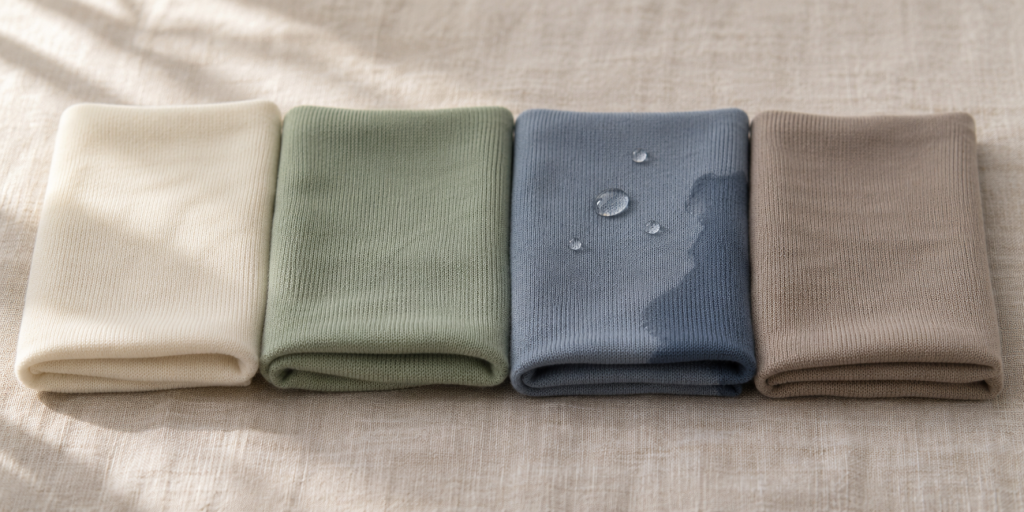
Conventional viscose loses strength when wet. Modal has higher wet strength than conventional viscose, while lyocell retains high strength in water. These properties help explain how the fibres respond to force during wet handling.
The word “strength”, however, can easily be read as a promise that a garment will keep its shape. Three measurements need to be distinguished:
A fibre can extend under a load well below the force needed to break it. High breaking strength and resistance to extension are therefore different properties. Neither, by itself, includes the arrangement of yarn in a T-shirt.
Knitting forms yarn into loops. Tension during manufacture and finishing affects their shape; water, agitation and drying can allow the yarn and loops to rearrange. Fibre swelling and the blend influence the movement, while finishing affects how much relaxation has already taken place before the garment is made.
A top that becomes shorter and wider after washing has changed its proportions. That can happen through loop relaxation without the fibres breaking. The change along the length may also differ from the change across the width, so one overall “shrinkage” figure can hide information relevant to fit.
For that reason, how knit shrinkage is measured matters when interpreting a result. Length, width, washing conditions and drying method belong together. “High wet strength” cannot replace those details.
Elastane contributes elastic stretch, while cotton, polyester, linen or another cellulosic fibre changes the combination being evaluated. The knitted structure determines how those yarns form the fabric. A fibre-level strength claim covers only part of that combination.
A light camisole fabric and a heavier trouser knit can both sit within viscose knit blends and weights. Among modal blends for soft everyday clothing, cotton/modal and modal/elastane compositions also provide different starting points for feel and stretch. Reading the full composition helps distinguish fabrics that share a familiar fibre name.
Two cupro blends developed by Runtang make this distinction concrete. P3378 contains 11.7% cupro, while P5551 contains 10%. The similar percentages sit within quite different fabrics:
| Fabric | Full composition | Construction | Fabric weight |
|---|---|---|---|
| P3378 | 35.3% modal, 11.7% cupro, 43.8% polyester, 9.2% elastane | Double knit | 230 gsm |
| P5551 | 80% lyocell, 10% cupro, 10% linen | Rib knit | 115 gsm |
At 230 gsm, P3378 has twice the weight per square metre of P5551 and includes elastane. P5551 is predominantly lyocell, with linen in the blend and a rib structure. Calling both “cupro blends” leaves out the main fibres, the elastic component and the way each fabric is knitted.
These differences explain why similar cupro content is a poor basis for expecting the same wash behaviour. Each fabric needs to be evaluated as a complete knit under the intended care routine. The same applies when comparing lyocell jersey and rib knit options: the full blend and construction establish what is being compared.
A garment can retain its dimensions yet lose the smooth appearance that made it appealing. Lyocell illustrates this clearly: high wet strength can coexist with fibrillation, where fine strands separate along the fibre under wet friction.
The fine strands alter the way the surface reflects light. On a dark fabric, the result can look pale or frosted. Pilling creates a different appearance, with loose fibres entangled into small balls; dye loss is another possible cause of a washed garment looking lighter. “Faded” or “fuzzy” describes the observation, but does not identify the mechanism.
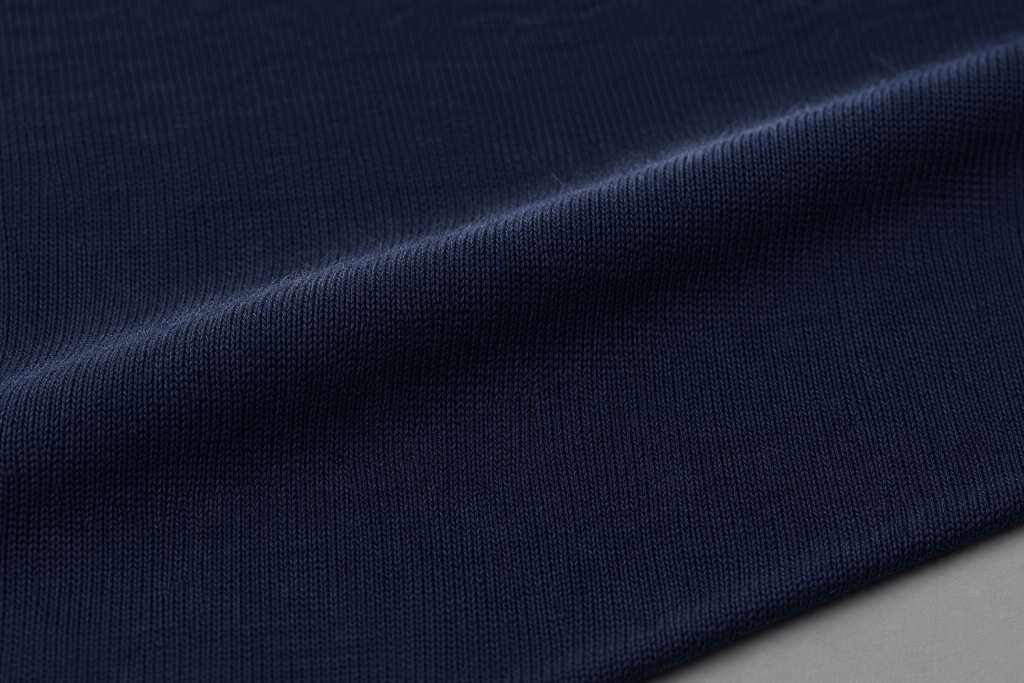
Fine surface fuzz can interrupt the smooth appearance of a dark knit. The close-up shows the detail to observe, rather than a diagnosis of fibrillation or a measured change after washing.
Repeated rubbing in one position during wet processing can concentrate the effect along a crease. An early patent study on lyocell fibrillation and persistent rope marks describes this type of pale, crease-like mark. It also reports that cellulase removal of surface fibrils did not remove the rope marks in the treatment discussed. An enzyme treatment should therefore not be read as a promise that every pale line will disappear.
A fine, peach-like surface may be a deliberate design choice. Its presence alone does not mean a fabric has been damaged. What matters is whether the texture is intended, even across the garment and reasonably maintained through care.
This is where a description such as “soft finish” needs context. How brushing and peaching change texture helps explain other routes to a raised or suede-like surface. An even texture present from the start is a different reference from a smooth top that develops isolated fuzzy patches after washing.
The purpose of washing information is to help someone judge whether clothing will remain useful and pleasant to wear. For a fitted top, that includes length and width after care. For a dark, smooth knit, the evenness of its surface may be just as noticeable.
A meaningful result relates to the actual fabric or garment, with its full blend and finish, under a stated washing and drying routine. Results from different care conditions answer different questions. A gentle wash followed by flat drying cannot establish how the same item will behave in a tumble dryer.
For someone buying clothes, the care label is the starting point. A fibre-strength claim does not authorise a different wash cycle. When more detail is available, item-specific information about fit and appearance after care is more useful than a general ranking of the fibres.
Coverage adds another consideration when the garment is light-coloured or close-fitting. This is a wearing requirement alongside wash performance: a fabric may retain its dimensions after care yet reveal more than intended when stretched or damp.
Water changes the boundaries between fibres and air, affecting how light is reflected and transmitted. A damp patch may consequently look darker, while greater transparency means more of the background or clothing underneath becomes visible. A darker mark alone does not establish how much coverage has changed.
The spacing between yarns, fabric weight, colour and fibre finish all influence the result. Stretching a knit can open its loops further. When considering coverage and recovery in loungewear knits, the relevant comparison is at the stretch reached during wear, using consistent lighting and background if dry and damp areas are compared.
Good wash performance therefore involves evidence about the finished item: its fit, surface and suitability for the stated care routine. Wet coverage answers an additional question about wearing it. Wet strength contributes to that picture, but cannot stand in for all of it.
No. A fibre's resistance to breaking does not establish the correct care routine for a finished garment. Its construction, finish, seams and trims also matter. Follow the item's care label, including the drying instructions, rather than choosing a cycle from a fibre-strength claim.
The percentage alone does not establish that result. Yarn, loop structure, finishing and the washing and drying conditions affect dimensional change. A comparison needs results for the actual fabrics under the same care conditions; more lyocell is not a substitute for that information.
Cupro can contribute to the feel, but its share does not describe the rest of the knit. P3378 and P5551 have similar cupro percentages yet different main fibres, structures and weights. Their washing behaviour needs to be assessed as complete fabrics.
No. Fibrillation can make a dark surface look pale, but abrasion, dye loss and other finishing effects can also alter its appearance. The position and texture of a mark provide clues. A photograph or fibre label alone cannot establish its cause.
A temporary dark patch shows a response to moisture, rather than necessarily a lasting change after washing. Judge fit and surface after the garment has been cared for and dried as instructed. If damp coverage matters during wear, assess that separately under consistent conditions.
 Fabric
Pique Knit Fabric: The Perfect Choice for Breathable and Stylish Sportswear
READ MORE Fabric
Tricot Fabric: Warp-Knit Lining Material with Distinct Knit
READ MORE Technical Know-How
Fabric Spirality and Shrinkage in Knit: Test Methods and Bulk Production Control
READ MORE Industry Insights
4 Kinds of Important Clothing Fabric Material
READ MORE Fabric
Waffle Knit: A Unique Texture for Casual and Stylish Outfits
READ MORE