Knit Fabric Manufacturer Since 2009 · China
Knit Fabric Manufacturer Since 2009 · China

Find our technical articles, sourcing guides and industry insights more easily.
A fleece that once felt comfortable starts clinging to your base layer and crackling when you take it off. Washing may have changed its surface treatment, but the surrounding humidity and the fabric rubbing against it also affect what you notice. An anti-static label describes a performance intention; its durability depends on the complete fabric and the conditions in which it is used.
The useful distinction is between generating charge and losing it. Contact can keep producing charge while moisture, surface treatments and conductive components help it redistribute or dissipate. Understanding those processes explains why a cotton blend, an anti-static finish and a conductive yarn can contribute in different ways—and why a fibre percentage cannot establish a wash lifespan.
As a fleece moves against another layer, the surfaces repeatedly contact and separate. This can leave them electrically charged. The amount and polarity depend on the contacting materials and their surface condition, as well as the circumstances of contact.
That makes a fleece and its base layer a pair worth considering. Changing the inner top changes one of the contacting surfaces, even though the fleece remains the same. A fixed list of fibres ranked from positive to negative provides an incomplete explanation of a finished garment combination.
Cling, attracted dust and an audible crackle are related observations, but they describe different effects. Cling involves attraction between surfaces; a crackle accompanies a discharge. Neither observation alone measures how quickly charge will decay on the fabric under controlled conditions.
Common polyester fibres take up little moisture and are electrically insulating. In dry conditions, charge can remain on the material rather than dissipating readily. Moisture associated with the fibre and its surface can change that behaviour.
Relative humidity is important here. Cold outdoor air is not automatically low in relative humidity, while heating air indoors without adding moisture can lower its relative humidity. A fleece may therefore behave differently after you move from one environment to another.
This is why a change noticed after laundry needs context. The garment may also be completely dry for the first time in a while, worn over a different top or used in a drier room. Washing history and wearing conditions both belong in the explanation.
An anti-static finish can alter surface electrical behaviour, including through its affinity for moisture. Its chemistry and the way it is retained on the fabric affect how it responds to laundering.
Textile finishing distinguishes between non-durable and durable anti-static treatments. A finish that is readily removed in washing behaves differently from a treatment designed to remain effective through a specified laundering exposure. Describing both simply as a chemical coating conceals that distinction.
The practical question is how the particular treatment performs after the intended care routine. There is no universal number of washes after which every anti-static finish disappears. A changed hand feel or a softer surface also cannot establish whether the original anti-static performance remains.
A conductive component provides a route for charge movement within a fabric. Its usefulness depends on its material, placement and interaction with the rest of the structure. Introducing conductive yarn during knitting is therefore a different design decision from applying a surface finish afterwards.
The arrangement matters alongside the amount. Where the conductive elements sit, how they are distributed and their relationship to the contacting surfaces influence the fabric's electrical behaviour. Identifying a conductive ingredient is a starting point for understanding the design.
Runtang's development records include a polar fleece with this formulation:
| Style | Fabric type | Recorded composition | Fabric weight |
| P4374 | Polar fleece | 95% polyester, 5% conductive yarn | 280 GSM |
Outerwear is listed as its reference application. The formulation shows that a conductive component is included in a polyester-rich fleece, while the GSM describes its mass per area. These details explain different aspects of the material: the polyester forms most of the fabric, and the conductive yarn introduces an additional electrical function.
The next useful information would be the conductive yarn's construction and arrangement in the knit. The record does not identify its conductive material or provide a wash-tested charge-decay result. It therefore supports an explanation of the design route, rather than a claim that this particular fleece remains static-free for a stated number of washes.
Within fleece fabrics with different constructions, weight, surface pile and fibre blend still shape the fabric's feel and use. Conductive content adds another property to consider; it does not replace those other design choices.
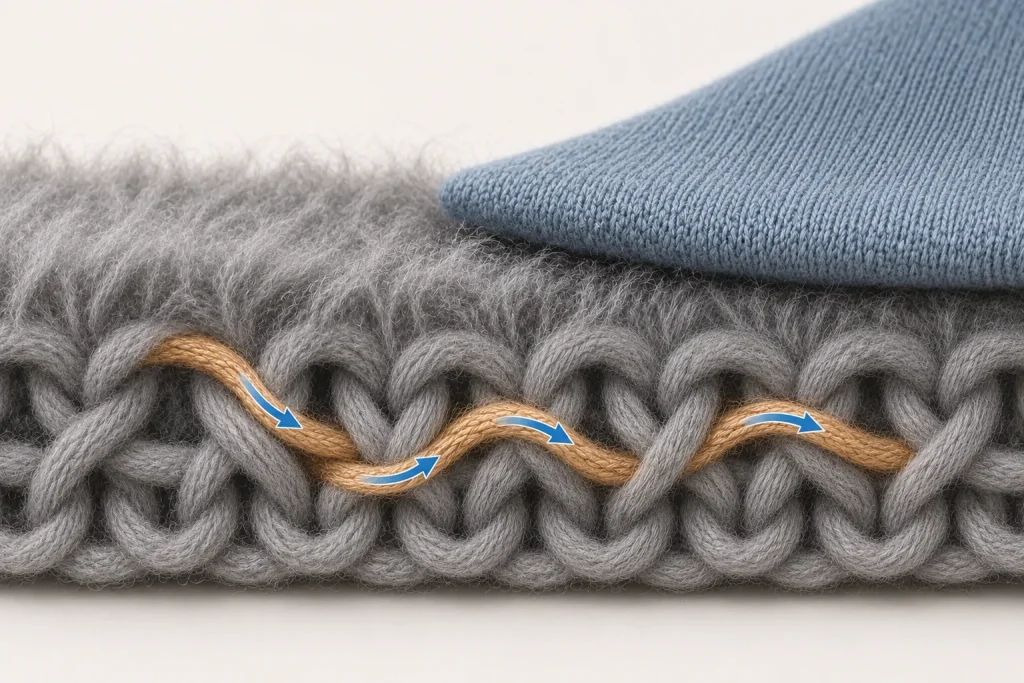
Adding cotton or another more absorbent fibre can change how a fabric interacts with atmospheric moisture. That can influence charge retention, while the contacting material, finishing and environment continue to matter.
Across cotton blends in different knit structures, the percentage tells you how much cotton is present. It does not describe every exposed surface or the electrical paths through the finished fabric.
Calculating an average moisture regain from a blend's ingredients cannot produce an anti-static grade. Moisture regain concerns moisture uptake under stated conditions; an electrical measurement concerns the finished specimen's response. The connection between them helps explain behaviour, but one value cannot stand in for the other.
The AATCC surface-resistivity test method measures fabrics after they have reached equilibrium with specified humidity and temperature conditions. It assesses electrical surface resistivity, which can influence charge accumulation.
A charge-decay measurement follows how an imposed charge changes over time under its stated test conditions. A decay time needs an identified starting condition and endpoint to be meaningful. These are different observations from simply hearing a spark when removing a top.
Published research on washing and conductive-fabric charge decay examined electrical resistance and decay-related measures before and after five wash cycles. The work used specified conductive-yarn fabrics, including woven protective fabrics, and considered humidity. Its reported resistance and decay measures did not all change in the same way.
That finding explains why a report should name the property being measured. A change in resistance is not automatically the same change in charge-decay time. The study's wash count describes its experiment, rather than a service-life promise for every fleece containing conductive yarn.
A useful before-and-after comparison identifies the fabric, laundering and drying procedure, number of cycles, conditioning environment and electrical method. With those details, the result describes a particular exposure and response.
Without them, “still anti-static after washing” leaves the reader unsure what changed and what was measured. For someone sourcing fleece, a report tied to the actual finished fabric and intended care routine is more informative than a conductive-fibre percentage or an unqualified durability claim.
For everyday use, follow the garment's care instructions. Softener, detergent and drying choices can affect surface behaviour, but their effects depend on the treatment system. Adding softener does not establish that a factory-applied function has been restored, and a temporary reduction in cling does not demonstrate a specified wash-durable result.
The next time a fleece behaves differently, consider what changed around it as well as what happened in the wash. The contacting layer and humidity help explain charge generation and retention; the fabric's construction and treatment help explain its routes for charge movement.
Not necessarily. Cotton can change moisture uptake and charge retention, but the complete fabric, surface treatment, relative humidity and material touching it still affect the result. Cotton percentage alone does not establish that a fleece will remain free of cling or discharge.
Conductive components can provide charge-movement routes that rely less on surface moisture than a moisture-dependent finish. Their effectiveness still depends on the actual material and fabric arrangement. Performance under dry conditions needs results obtained under relevant conditioning conditions.
It may alter surface behaviour and reduce cling in some circumstances, but that does not demonstrate restoration of the original treatment or its durability. Follow the care instructions for the particular fabric, especially where functional finishing is involved.
Those are separate properties. Pilling concerns tangled fibre balls on the surface; anti-pilling finishing in polar fleece is intended to limit that surface change. Shedding concerns fibres leaving the fabric, while anti-static behaviour concerns electrical charge. They may all be affected by laundering, but evidence for one does not establish the others.
 Technical Know-How
Rib Knit Fabric Shrinkage and Recovery: What to Check Before Bulk Production
READ MORE Fabric
Velour Knit Fabric: A Luxurious Choice for Everyday Comfort
READ MORE Industry Insights
What Should You Think About on Purchasing Jacquard Knit Fabric
READ MORE Fabric
Tricot Knit: Understand This Lightweight and Durable Material
READ MORE Sourcing Guide
Waffle Knit Fabric GSM Guide for Apparel Brands
READ MORE