2009年創業のニット生地メーカー · 中国
2009年創業のニット生地メーカー · 中国

Most knit fabric orders go sideways before production starts. Vague GSM targets, skipped shrinkage checks, and unresolved lab dip rounds are the real culprits. This guide maps the fabric sourcing workflow that buying teams at apparel brands use to close that gap: from writing a spec sheet a knit mill can act on, to signing off bulk before production begins.
Quick Answer: The Knit Fabric Sourcing Workflow at a Glance
A reliable fabric sourcing process for knit apparel moves through five decision gates:
Each gate catches a different class of problem. Skipping any one move that problem into cut-and-sew, where fixing it costs multiples more.
The most common failure point in knit fabric sourcing is not a bad mill — it is an incomplete brief. When a buying team sends a vague request ("cotton jersey, medium weight, for T-shirts"), what they get back is a swatch selection, not a sourcing confirmation. The mill is guessing what the brand actually needs, and the brand is evaluating swatches against criteria they have not written down yet.
This loop — request, swatch, counter-request — can add extra sampling time and push color approval closer to the bulk deadline. For seasonal programs with fixed drop dates, that is not just a scheduling issue; it can delay product launch decisions.
The root causes are consistent across most brands entering knit fabric sourcing for the first time or scaling into new categories:
None of these are design decisions. They are engineering decisions, and they belong in the fabric brief, not in the sampling conversation.
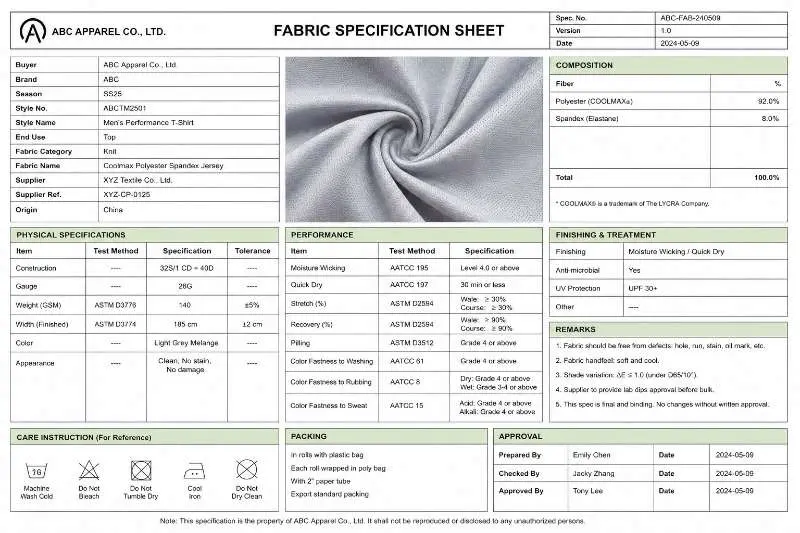
A knit mill prices, samples, and schedules based on whatever information it receives in the initial inquiry. The more complete and technically specific that information is, the more accurate the mill's response will be — and the fewer revision rounds the sourcing process will require.
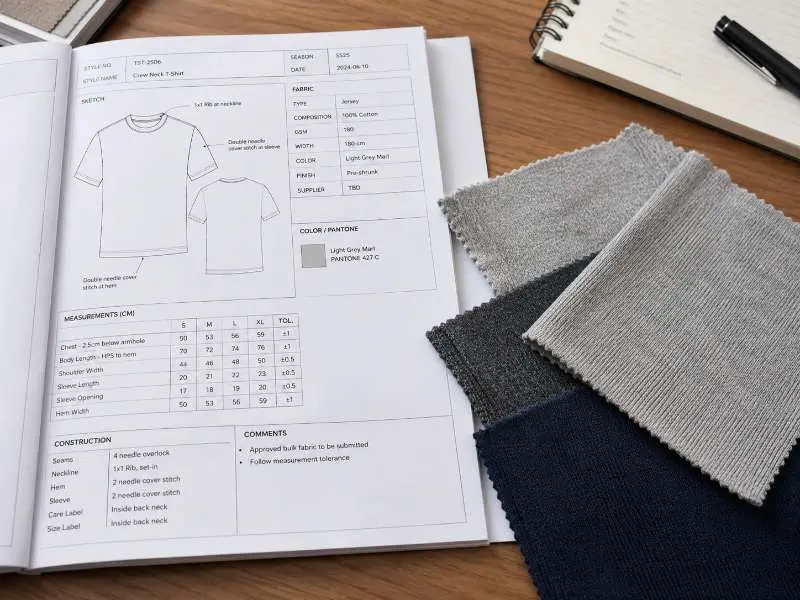
The following spec dimensions are the minimum required to open a structured knit fabric sourcing conversation:
| Spec Dimension | What to Specify | Why It Matters |
|---|---|---|
| Fiber composition | Primary fiber + secondary fiber(s) + spandex %, with ±2–3% tolerance range | Determines hand, stretch, dyeability, and certification eligibility |
| GSM target | A directional target with ±10–15 GSM tolerance, not a 100+ GSM range | Controls fabric cost, yield per roll, and end-use suitability |
| Cuttable width | Minimum cuttable width in cm, based on your pattern's widest cut piece | Directly affects fabric yield and cost per garment calculation |
| Construction type | Single jersey/interlock/rib/pique /etc. | Determines knitting machine and MOQ; not all mills run all structures |
| Functional finishes | List all required finishes (brushing, anti-pill, wicking, enzyme) | Finish requirements affect dyehouse routing and lead time |
| Color reference | Pantone TCX code or physical reference swatch | Without this, lab dip approval rounds increase by default |
| Certification requirements | OEKO-TEX® Standard 100 / GRS / GOTS — confirm certificate scope before sampling. | Certification scope affects yarn procurement and mill eligibility |
| MOQ tolerance | Your minimum order per color and whether you can consolidate colorways | Affects whether the mill can accommodate the order at all |
A practical rule: if a parameter on this list is left blank, assume the mill will fill it in based on what is easiest to produce, not what is best for your garment. The spec sheet is the brand's primary control mechanism in the fabric sourcing process.
Construction choice should also be confirmed before sampling. For lighter tops, jersey knit fabric is usually reviewed as a single-knit option; for better opacity and dimensional stability, interlock knit fabric is often the safer starting point. Both should be checked against the same GSM, width, shrinkage, and color approval requirements before bulk ordering.
For brands that run multiple categories — knit tops, bottoms, outerwear liners — it is worth maintaining a master spec template by category, updated after each sourcing cycle. The time invested in that template pays back across every subsequent season.
Physical sampling is where the fabric sourcing process shifts from documents to materials. A sample that passes visual review is not a sample that has passed sourcing qualification. Knit fabrics behave differently from woven fabrics under stress, washing, and cutting — and those behaviors only become visible through testing.
The following checks should be run against every knit sample before a sourcing decision is made:
| Check | What You Are Looking For |
|---|---|
| GSM verification | Weigh the fabric sample according to the agreed testing method and compare it with the approved GSM target. |
| Dimensional stability (shrinkage) | Wash and dry a sample per the intended care instruction. Mark a measured test area before washing and compare the result after care testing. Some knit constructions can show higher shrinkage than woven fabrics, so the acceptable range should be confirmed by construction, end use, and buyer tolerance. |
| 伸縮性と回復性 | Extend the sample to a defined percentage of stretch in the course and wale directions, hold, release. Measure recovery according to the buyer’s agreed test method or internal QC standard. Poor recovery indicates insufficient spandex content or yarn tension issues. |
| Spirality (torque) | Lay the washed sample flat. Observe whether the side seams twist forward. Spirality beyond the buyer’s approved tolerance can cause garment twisting in wear and should be reviewed before bulk approval. |
| Colorfastness (preliminary) | Check whether the sample shows bleeding when rubbed against a white cloth (dry and damp). This is a field check, not a lab standard — formal colorfastness testing comes later. |
| Surface consistency | Inspect the full sample panel for pilling, uneven shearing, needle lines, or holes. These are production defects at sample stage that will multiply in bulk. |
| Hand vs spec intent | Compare the sample hand feel to your reference swatch. 'Softer than expected' or 'stiffer than expected' are both rejection reasons if the spec intent is clear. |
For formal GSM verification, fabric weight should be checked with the agreed testing method, such as ASTM D3776/D3776M, which covers mass per unit area testing for most fabrics. A sample that fails one or more checks should be returned with specific written comments — not just a "please revise" message. The more precise the feedback, the faster the next round resolves the issue.
Most knit fabric sourcing processes require two to three sampling rounds for custom developments. Standard stock fabrics from a mill the brand has worked with before may clear in one round. Budget the timeline accordingly.
One note on sample yardage: ordering enough fabric to cut a full prototype garment — not just a laboratory coupon — is worth the extra cost. Garment-scale testing reveals cutting behavior, seam performance, and print registration issues that a 30cm × 30cm lab sample cannot.
Lab dip approval is the most reliably underestimated stage in the entire knit fabric sourcing timeline. It is also the stage where most bulk order delays originate — not because the mill is slow, but because the approval process is managed reactively rather than proactively.
A lab dip is a small-scale dye test on the target fabric construction, submitted to the brand before bulk dyeing begins. Its function is to confirm that the production dyehouse can hit the color target within tolerance before committing to full rolls.
The structural problems that create delays at this stage:
Brands that manage lab dip approval well treat it as a parallel workflow that runs alongside — not after — sample approval. The color target should be locked and submitted to the dyehouse at the same time the structural sample is being reviewed. This compresses the overall sourcing timeline without compressing the quality of either review.
For a detailed breakdown of lab dip tolerances, approval workflows, and common bulk color problems, see our guide: Lab Dip Approval for Knit Fabric: Workflow, Tolerances and Common Bulk Color Issues.
Bulk receipt inspection is the final checkpoint in the fabric sourcing process before fabric moves to cut-and-sew. It is also the point where brands most frequently discover that what was approved in sample does not match what was shipped in bulk — because the two were produced under different conditions.
Common sources of bulk-to-sample deviation in knit fabrics:
The following bulk inspection sequence addresses these risks in order of detection difficulty:
| Inspection Step | Method |
|---|---|
| Roll-end sampling | Pull a 1–2 meter cut from each roll end. Do not sample only the outer wrap — it may have been exposed to light or handling damage not representative of the roll body. |
| Shade banding | Cut strips from representative rolls, stitch them side by side, and inspect under the buyer’s approved light source. Rolls that read visibly different from the approved bulk standard should be flagged. |
| GSM spot check | Weigh cuts from an agreed roll sampling plan. Compare against the approved sample weight and purchase-order tolerance. Any deviation beyond tolerance should trigger wider roll checking. |
| Shrinkage correlation | Wash and measure a cut from the bulk rolls using the same protocol used during sample approval. Compare results. A significant difference may indicate a change in finishing — most likely in heat-setting temperature or tension. |
| AQL visual inspection | Inspect fabric rolls for surface defects under controlled lighting. The inspection level, defect classification, and acceptable quality limit should be defined in the purchase order before inspection begins. |
Brands that do not run shade banding on bulk receipts regularly discover shade variation after panels are cut — at which point the only options are absorbing visible garment inconsistency or scrapping material. Neither is recoverable from a cost or timeline standpoint.
The fabric sourcing process ends when the bulk has been inspected, the release criteria have been met, and the fabric is formally approved for production. Any roll that does not pass inspection should be quarantined and documented — not set aside informally for use in a later order.
At minimum: fiber composition with tolerance ranges, a GSM target (not a wide range), cuttable width, construction type, finish requirements, a color reference (Pantone TCX or physical swatch), certification requirements, and MOQ parameters. A spec sheet missing any of these gives the mill room to make decisions that should belong to the brand.
Custom knit fabric developments commonly require two to three rounds — one for structure and hand, one or more for color and finish adjustments. Stock fabrics from an existing mill relationship may clear in a single round. Building at least two rounds into the project timeline prevents schedule compression when a revision is needed.
Yes, and it is recommended. Submit the color target to the dyehouse at the same time the structural sample is being evaluated — not after. The two reviews are independent and can run in parallel without risk. Most fabric sourcing delays at the lab dip stage are caused by sequential rather than parallel workflows.
Ready to start a knit fabric sourcing inquiry? Share your spec sheet or tech pack with us to receive a structured sample proposal — including GSM options, construction recommendations, and lead time.