Match a Sample
Send a fabric or garment you want reproduced. We analyse it and develop a fabric with the same construction, weight, width, hand feel and surface.
2009年創業のニット生地メーカー · 中国

当社技術者+第三者ラボ
1~2 m、通常2~3回
承認サンプルまで15~20日
小ロール、約15~20 kg
All three follow the same process: analyse, trial on a few metres, then make the sample the way bulk will be made.
Send a fabric or garment you want reproduced. We analyse it and develop a fabric with the same construction, weight, width, hand feel and surface.
Send a sample as a starting point and tell us what to change, for example a softer hand, a lighter weight or a different surface. We develop from the reference toward your target.
No sample? Describe the end use, hand feel, weight, width, composition and surface effect you want, and we develop trials toward that brief.
Our technicians and an independent laboratory analyse the same sample, and we cross-check the results.
When your sample arrives, we cut it into two pieces. One goes to our production technicians, who have 20 to 30 years of experience and take the fabric apart by hand. The other goes to an independent textile testing laboratory we work with regularly. Both analyse the same points, and we compare the two sets of results before any yarn is bought. If they disagree, we find out why first, because a mistake at the analysis stage would be carried into every step after it.
| What is determined | Why it matters |
|---|---|
| Fibre composition | Decides which yarns to buy and how the fabric will be dyed. Measured by the laboratory, not estimated. |
| Yarn count of each yarn | With stitch length, yarn count sets the weight and density of the fabric. |
| Knit structure and machine type | Single jersey, double jersey (interlock), rib or jacquard: the structure decides which machine can knit it. |
| Machine gauge and cylinder diameter | Gauge (needles per inch) controls how fine the fabric is; cylinder diameter and gauge together decide the greige width. |
| Stitch length of each yarn (mm per 100 needles) | The length of yarn knitted into 100 loops. It is the main setting that controls weight, width and shrinkage. |
| Dyeing and finishing route | Judged from the hand feel and surface of the original, for example brushing, peaching, mercerizing or softening. |
Stitch length is measured on yarn unravelled from the sample, and is also calculated from the width and density the fabric needs to have. Our technicians check both figures against their experience of similar fabrics. (A standard method for measuring stitch length and yarn linear density in weft knit fabrics is EN 14970.)
The laboratory analysis is a working check for development, not a formal test report. Formal reports for bulk orders are covered on our fabric testing page.
One or two metres show whether the construction is right before time and yarn go into a full sample.
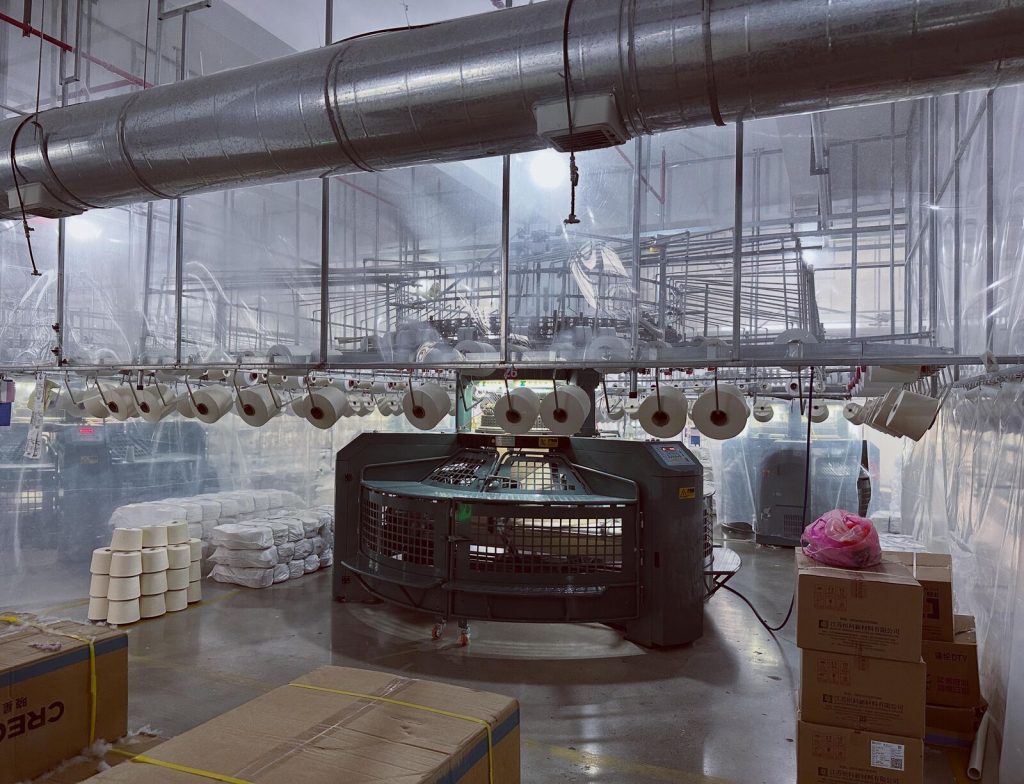
We buy the yarns identified in the analysis, set up the knitting machine to the calculated stitch lengths, and knit only one or two metres of greige fabric before stopping the machine.
That short piece goes straight to our laboratory, where it is scoured, simply dyed and dried on sample equipment. This shows within a short time what the fabric will roughly look like after wet processing, and we compare it with your original on four points:
If the trial is close to the original, or moving in the right direction, we go on to the development sample. If it is far off, we adjust the machine settings and knit another short trial. Most developments are on target after two or three rounds.
Why such a short trial? A knit fabric changes a great deal when it is scoured, dyed and finished: it relaxes, shrinks and gains weight. Greige-stage measurements are useful mainly for early corrections, so we check a wet-processed trial rather than raw greige, and we keep each trial small. The less yarn spent on trials, the more of the yarn bought for your development ends up in the sample you receive.
The sample you approve is made the way your bulk order will be made.
Once a trial is on target, we knit about ten metres of greige fabric with the confirmed settings and dye and finish it in our dyehouse on the bulk production lines, using the bulk production process. This is a first bulk-process run of your fabric. When we are satisfied with it, and you too if you would like to see it first, the rest of the yarn bought for the development is knitted and finished the same way to make your development roll. If you only need the ten metres for sample garments, the remaining yarn is kept for your bulk order. A sample made only in a laboratory can look right but behave differently at production scale; a sample made on bulk lines gives process data we can repeat.
At every stage, from greige to finished fabric, we record the data and keep a retained sample. Typical records include:
If the first finished fabric is not yet the same as your original, these records and retained samples show at which stage it changed, so we correct that stage rather than starting again.
From receiving your sample to sending the approval roll usually takes 15–20 days.
A fabric to match, a reference to improve, or a written brief with end use, weight, width and hand feel.
Our technicians and a third-party lab each determine composition, yarn counts, structure, machine type, gauge and stitch lengths; the results are cross-checked.
Stitch lengths are set from the required width and density; the yarns are bought.
The machine is set up and a short piece of greige fabric is knitted.
The trial is scoured, dyed and dried in our lab and compared for appearance, weight, width and shrinkage. Adjust and repeat if needed, usually two or three rounds.
With the settings confirmed, about ten metres of greige fabric is knitted.
The ten metres are dyed and finished on bulk lines with the bulk process as a first bulk-process run; data and retained samples are kept at every stage.
Once the run matches your original or brief, the remaining yarn is knitted and finished the same way and we send you a small roll, usually about 15–20 kg, or just the ten metres if that is enough for your sample garments.
A 15–20 kg roll is enough to cut and sew samples, wash-test them and show them to your buyers, not only to look at.
Yarns for a development are bought in small-roll quantities. Trials use part of that yarn, which is why we keep them short: more of it ends up in the roll you receive. Any yarn left over is kept for your bulk order.
Developments carry a machine set-up fee and a small-lot dyeing fee. With a bulk order of 3,000 kg or more, these fees can be credited back; details are agreed with you case by case.
Bulk is produced to the data and retained samples recorded during development: the same yarns, knitting settings, dyeing recipe and finishing process. The approved roll and the development records are the standard we produce to and check against.
If you need other colours, each one is approved on lab dips dyed on the developed fabric.
A newly developed fabric starts from 1,000 kg of greige fabric, which can be dyed in up to five colours, with at least 200 kg per colour.
Bulk lots are tested to the methods agreed in your order. Fabric testing →
A development is only finished when we can make it again. That is why the sample is made on bulk lines and every stage is recorded. — Xiwen Zhang, Co-founder & CEO
We cut the sample in two. Our technicians and an independent textile lab each determine the composition, yarn counts, knit structure, machine type, gauge and stitch length, and we cross-check the results. We then knit 1–2 metre trials and check them in our lab after scouring and dyeing, and once a trial is on target we make the development sample on our bulk dyeing and finishing lines.
From receiving your sample to sending the approval sample usually takes 15–20 days, with two or three trial rounds.
Yes. Send a brief with the end use, hand feel, weight, width, composition and surface effect. We can also start from a reference sample and change the points you want, such as a softer hand or a lighter weight.
Usually a small roll of about 15–20 kg, enough to make and test sample garments. If you only need fabric for a few sample garments, the first ten metres can be enough, and the remaining yarn is kept for your bulk order.
Yes. A development carries a machine set-up fee and a small-lot dyeing fee, because the sample is knitted on production machines and dyed and finished on bulk lines. With a bulk order of 3,000 kg or more, these fees can be credited back; details are agreed case by case.
Bulk is produced to the yarns, knitting settings, dyeing recipe and finishing process recorded during development, and is checked against the approved roll and retained samples.
A newly developed fabric starts from 1,000 kg of greige fabric, which can be dyed in up to five colours with at least 200 kg per colour.
Send us your fabric sample or brief with the end use, target quantity and colours. We will confirm the development plan, fees and timing before we begin.
Get a Quote →