Set the Tester
Readings within 10–90% of full scale; speed 300 ± 10 mm/min.
2009年創業のニット生地メーカー · 中国

試験方法 · GB/T 19976 · ISO 13938-1
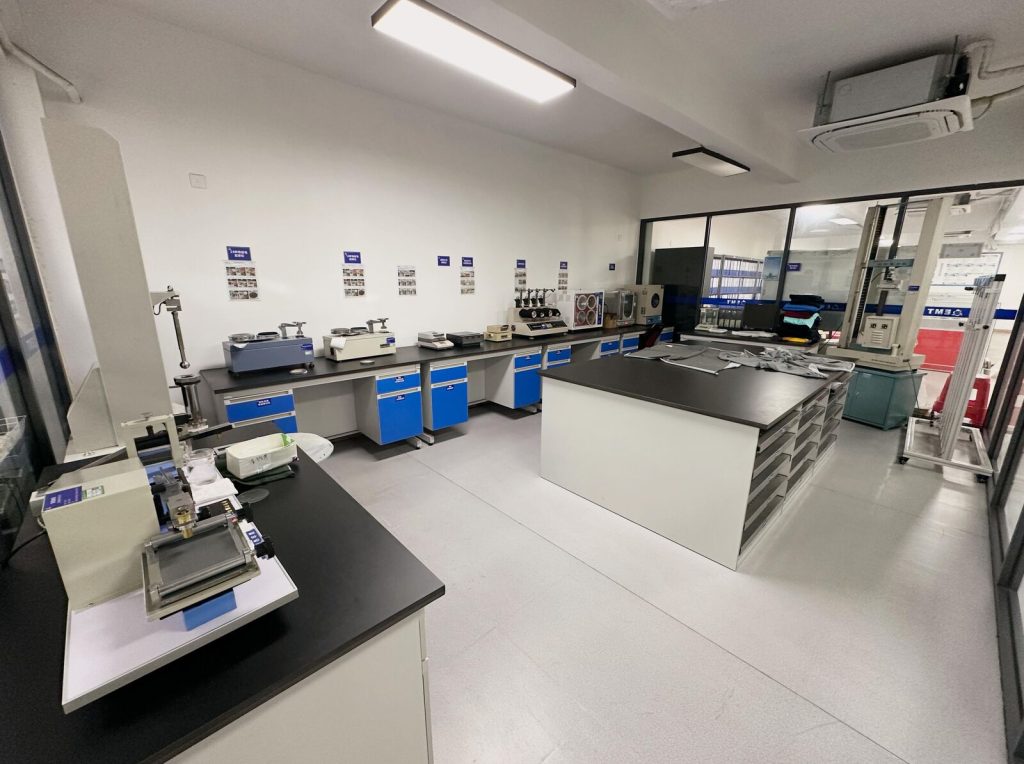
破裂強度は、鋼球やダイヤフラムがニット生地を突き破るまでに生地が耐える力を示します。当社では鋼球法(GB/T 19976、ASTM D6797に類似)で試験を実施しています。欧州の仕様書では油圧式のISO 13938-1が引用されることが多くあります。
GB/T 19976 鋼球法
ASTM D6797 / D3786
N(鋼球法)· kPa(油圧法)
Knits stretch in every direction, so a bursting test, which pushes against the fabric from one side like an elbow or knee, describes how they fail in use.
Ball methods (GB/T 19976, ASTM D6797) report force in newtons; diaphragm methods (ISO 13938-1 hydraulic, ASTM D3786) report pressure in kilopascals. The two cannot be converted.
Our technicians follow a written work instruction for this method.
Our lab runs the steel ball method; hydraulic testing is arranged with third-party labs when an order requires it.
Readings within 10–90% of full scale; speed 300 ± 10 mm/min.
A 25 mm or 38 mm polished steel ball, as agreed.
The specimen is clamped flat, back facing the ball, and burst.
Peak force in newtons; mean of at least five specimens.
Key settings. Write the method and procedure in your specification.
| Parameter | Setting |
|---|---|
| Method | GB/T 19976-2005, steel ball |
| Ball | 25 or 38 mm |
| Speed | 300 ± 10 mm/min |
| Specimens | At least 5 |
| Equivalent methods | ASTM D6797 / D3786 (US) · GB/T 19976 (China). Compare methods → |
Ask us for results for the selected fabric, shade and test conditions. Acceptance values for your order are agreed in writing.
Newtons belong to ball methods; kilopascals to diaphragm methods.
Some templates call ISO 13938 “tear resistance”. It is a bursting test.
For ball methods, state 25 mm or 38 mm.
No. ISO 13938-1 and -2 are bursting tests with a hydraulic or pneumatic diaphragm. Tear tests such as ISO 13937 are mainly for woven fabrics.
No. The methods load the fabric differently, so there is no reliable conversion.
Knits stretch in all directions and fail under multi-directional load; a bursting test reproduces that load.