Prepare the Specimen
A 40 × 100 mm specimen is sewn along one short edge to a multifibre strip of the same size, with white polyester thread.
Breistoffenfabrikant sinds 2009 · China

TESTMETHODE · ISO 105-C06
ISO 105-C06 meet kleurverandering en afgeven in een versnelde huishoudelijke of commerciële was. Onze gebreide stoffen meten cijfer 4 tot 4-5 voor kleurverandering. Het Amerikaanse equivalent is AATCC 61.
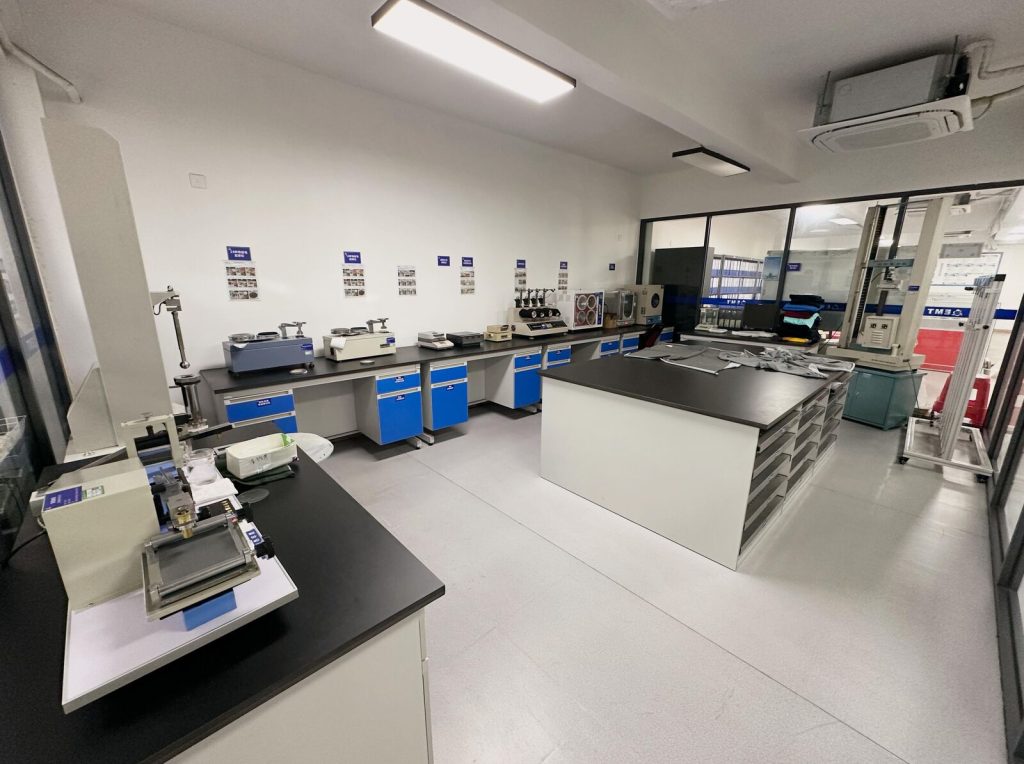
ISO 105-C06:2010
AATCC 61
Verandering 4 tot 4-5
Grijstinten, 1–5
A fabric specimen is sewn to a multifibre strip of six fibres and washed in a closed steel container with detergent solution and steel balls, then rinsed and dried. Technicians grade the colour change of the specimen and the staining of each fibre.
The procedure code sets the severity: the letter sets the temperature (A = 40 °C, B = 50 °C, C = 60 °C and higher), the figure sets the solution, for example whether sodium perborate is added, and S or M stands for a single or multiple-wash simulation. A1S is the mildest common procedure; A2S adds perborate at the same temperature.
Our technicians follow a written work instruction for this method.
Each specimen is washed under the procedure code agreed for the order.
A 40 × 100 mm specimen is sewn along one short edge to a multifibre strip of the same size, with white polyester thread.
The composite goes into a 550 ml steel container with 150 ml of solution and 10 steel balls (A1S: 4 g/L ECE reference detergent), at 40 ± 2 °C and 40 ± 2 rpm for 30 minutes.
The specimen is rinsed, squeezed and dried at no more than 60 °C.
Graded with the ISO 105-A02 grey scale for colour change and A03 for staining (AATCC EP1/EP2 for AATCC methods), under the agreed light source in a light booth, by at least two technicians.
Key settings. Write the method and procedure in your specification.
| Parameter | Setting |
|---|---|
| Procedures we run most | A1S (40 °C, 30 min) · A2S (40 °C, 1 g/L sodium perborate, 30 min) · A1M (40 °C, 45 min) |
| Detergent | ECE reference detergent B, without optical brightener, 4 g/L |
| Liquor and balls | 150 ml, 10 steel balls (6 mm) for A1S, A2S and A1M |
| pH | Not adjusted for A and B; C, D and E adjusted to pH 10.5 ± 0.1 |
| Beoordeling | Grey scales ISO 105-A02 and A03, 1–5 |
| Equivalent methods | AATCC 61 (US) · GB/T 12490 (China). Compare methods → |
Results depend on fibre, construction, shade and finishing.
| Fabric / shade | Ons gemeten bereik | Values in buyer specifications |
|---|---|---|
| All our knit fabrics, colour change | Grade 4 to 4-5 | Grade 4-5 |
| SGS example (chenille knit, A2S) | Change 4-5; staining 4 to 4-5 | — |
“Our measured range” comes from our own test records on bulk lots. “Values in buyer specifications” are requirements we have received; the value that applies to your order is the one written into it. — Xiwen Zhang, Co-founder & CEO
Write the full code, for example ISO 105-C06 A2S or AATCC 61 2A. “Washing fastness 40 °C” does not say whether bleach is used or how many washes are simulated.
Give one grade for colour change and one for staining.
State whether one value applies to all shades or whether dark shades have their own staining value.
A2S is a single-wash procedure at 40 °C with 4 g/L ECE detergent and 1 g/L sodium perborate, 150 ml of solution and 10 steel balls for 30 minutes. A1S is the same without perborate.
Our knit fabrics measure grade 4 to 4-5 for colour change in ISO 105-C06. We confirm the expected staining result for your shade before the order.
No. Both are accelerated laundering tests in similar equipment, but detergent, temperature, liquor volume and number of steel balls differ, so results are not interchangeable.