2009年創業のニット生地メーカー · 中国
2009年創業のニット生地メーカー · 中国

Luster is easy to achieve in a sample. Keeping it consistent across a 500 kg bulk order — and matching it on reorders six months later — is what actually separates a viable mercerized cotton program from a one-season gamble. Before sampling, sourcing teams need to understand how construction choice, yarn count, and finishing sequence affect what arrives at the cut-and-sew floor.
Mercerization treats cotton yarn or fabric in a sodium hydroxide (NaOH) solution under tension, permanently restructuring fiber cross-sections from a flat kidney shape toward a rounder profile. The practical result for knit apparel buyers: dye penetrates more evenly, surface luster increases, and tensile strength can improve — but these gains come with tradeoffs that become visible at scale.
The concentration of NaOH, fabric tension and finishing control can all affect how evenly luster appears across a roll. These variables are difficult to judge from a small swatch, so buyers should not approve mercerized cotton knit fabric based only on a 2-meter sample. Before bulk approval, request a full-roll shade continuity check and confirm whether width, shrinkage and surface sheen remain stable after finishing.
Key pre-sampling question: How is mercerization managed within the selected production route? The answer may vary by yarn, knit construction and finishing requirement, so it should be confirmed with the mill during sampling rather than assumed from a standard process description.
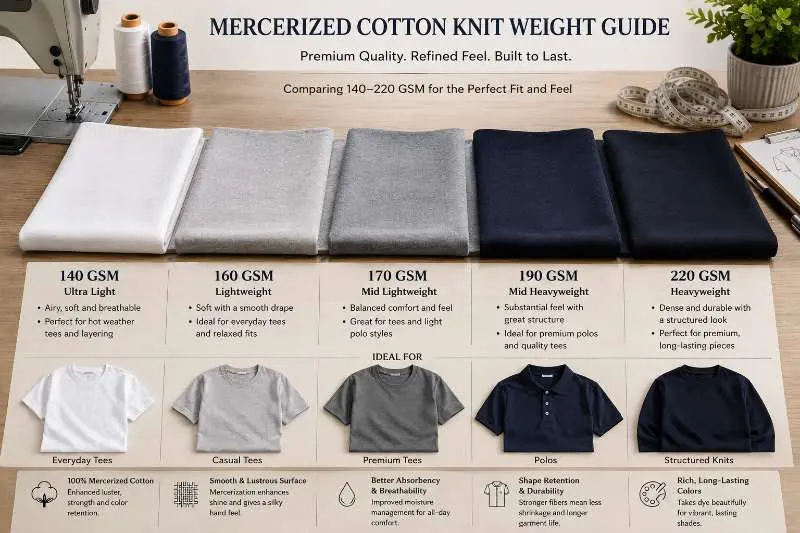
Mercerized cotton knit fabric for apparel is often developed within the 140–220 GSM range, though the right spec depends on garment category, opacity target and post-finishing shrinkage control.
Yarn count is not just a surface quality variable — it directly affects dye uptake rate and therefore the shade achievable in bulk. A mismatched yarn count between sampling and bulk production is a common source of lab-dip-to-bulk color drift. Lock in yarn count on the sampling brief, not after approval.
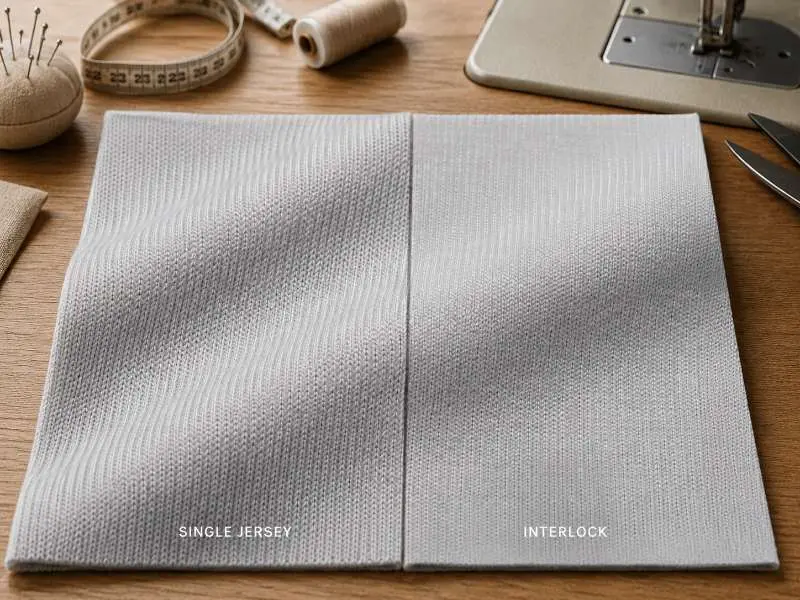
The choice between single jersey construction and interlock affects both the surface luster profile and the dimensional behavior after mercerization:
Single jersey mercerized cotton has one smooth face and one textured reverse. Luster is concentrated on the face. Because a single jersey has natural stretch and curl at the selvedges, tension control during finishing is important; uneven handling may increase the risk of width variation or inconsistent sheen. This construction suits drapy, lightweight programs where surface sheen is the primary premium signal.
Mercerized cotton interlock is more suitable when buyers need a smoother double-face structure and better dimensional stability across the roll. For polo programs, mercerized cotton piqué for polo shirts should be evaluated separately, because piqué texture, stitch definition and collar matching create different approval points from interlock.
Structural pre-sampling checklist before committing to construction:
Color repeatability is one of the highest-risk approval points for mercerized cotton knit programs, especially when the same shade is reordered across seasons.
A shade band should define the acceptable color range across the production lot. The ΔE tolerance should be agreed during lab dip approval based on the brand’s internal standard, end-use and color sensitivity, rather than assumed from a generic chart.
For reorders — which are where real color drift risk sits — the shade band from the original production run must be retained as the reference standard. If a different yarn lot is used in a subsequent order, a new lab dip cycle is required even if the color code is identical, because yarn lot variation affects dye uptake. For information on how finishing choices interact with color approval workflows, see the overview of fabric finishing for knit apparel.
Cross-season repeatability checklist:
For polo shirt production, 170–190 GSM is often a practical starting range for single jersey or piqué structures. Lighter 140–160 GSM options may work for fine-gauge programs, but buyers should confirm opacity, collar matching and post-finishing shrinkage before approval. GSM should be set with the fabric structure and lab report, not from a fixed chart.
OEKO-TEX® Standard 100 certified options are available. Please confirm certification requirements at the time of sampling, including product class, certificate scope and whether the selected yarn, dyeing and finishing route are covered. For custom solid colors, MOQ generally starts at 200 kg per color; stock availability and certified options should be checked separately before quotation.
Ready to verify luster and color depth on a real sample? Request a sample of our mercerized cotton knit fabric with a shade band reference and shrinkage report included — so your team evaluates what bulk performance actually looks like before committing.