Tillverkare av stickat tyg sedan 2009 · Kina

Tillverkare av stickat tyg sedan 2009 · Kina

Key Sourcing Takeaways
Textile traceability now affects supplier approval, certification claims, and EU-facing compliance records. Before placing knit fabric orders, buyers need to verify whether fiber origin, certification scope, yarn sourcing, and batch records can be traced to the actual production lot.
Most apparel buyers only see the direct supplier handling the finished fabric order. Behind that supplier, traceability may involve knitting or dyeing mills, yarn spinners, fiber processors, and raw material sources. For clarity, define tiers by the actual sourcing route used in the order, then request matching documents for each handoff. The key issue is not the tier label itself, but whether the certificate, invoice, batch number, and material claim can be connected.
Knit fabrics present a specific complication: circular knitting often blends yarns from multiple sources within a single fabric construction. A 200 GSM cotton-modal jersey, for example, may draw cotton from one spinner and modal from another — each with its own certification status, batch documentation, and chain of custody. When a mill sources yarns from multiple Tier 2 suppliers, the traceability burden multiplies.
Three regulatory developments are increasing documentation pressure. The EU Corporate Sustainability Due Diligence Directive (CSDDD, Directive 2024/1760) entered into force in July 2024 and pushes in-scope companies to identify and address human rights and environmental risks across global value chains, as explained in this CSDDD apparel and footwear overview. For textiles, Digital Product Passport requirements are still being defined, with textile-specific delegated acts expected around 2027 and implementation likely after a transition period. For buyers, the practical response is clear: start collecting fiber origin, certification scope, supplier mapping, and batch-level records before bulk orders are placed.
For brands sourcing knit fabrics, these frameworks translate into a practical shift: suppliers who cannot provide structured, per-lot documentation are increasingly a liability, regardless of their production quality.
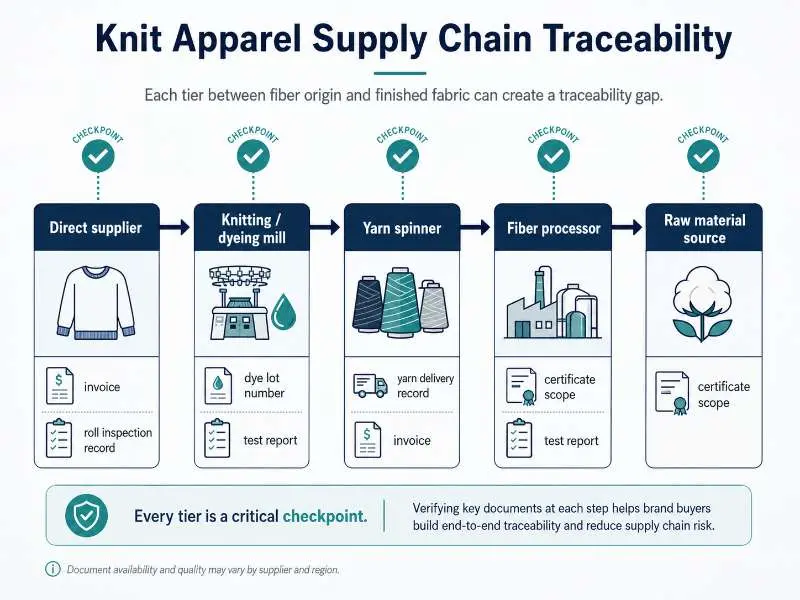
Traceability in knit fabric sourcing operates across three distinct layers. Conflating them — or accepting documentation that covers only one — is the most common verification error buyers make.
Certifications such as the Global Recycled Standard (GRS), Global Organic Textile Standard (GOTS), and Recycled Claim Standard (RCS) operate on a Chain of Custody (CoC) model. Each actor in the supply chain — the fiber producer, the yarn spinner, the fabric mill — must hold their own valid certification for the claim to transfer downstream.
What to request: A Scope Certificate (SC) for each certification the mill claims to hold. The SC is issued by an accredited certification body and confirms the facility, the product scope, and the certification validity period. Scope Certificates are publicly searchable through certification body databases — always verify independently rather than accepting a PDF copy alone.
What an SC does not prove is that your specific order was produced under that certification. For chain-of-custody standards, buyers should also request a Transaction Certificate (TC) where applicable. A TC links a certified material claim to a specific shipment, lot, quantity, and invoice. For OEKO-TEX® Standard 100, verify the certificate number and product scope instead of asking for a TC.
Beyond material certification, buyers should verify that the mill maintains facility-level documentation that supports due diligence under CSDDD and equivalent frameworks. This includes third-party social compliance audits (BSCI, SMETA, or equivalent), environmental compliance records, and evidence of sub-supplier management policies.
For buyers sourcing into EU markets under CSDDD scope, mills should be able to demonstrate they have mapped their own Tier 2 suppliers — yarn spinners at a minimum — and can provide documentation on those relationships. A mill that can only account for its own facility, but not the origin of the yarns it purchases, cannot support a credible downstream due diligence claim.
The most operationally specific layer is batch documentation: records that link a delivered fabric roll to a specific production run, dyeing lot, and input materials. For brands needing to substantiate ESG claims at the product level — or to comply with Digital Product Passport requirements — this is the layer that matters most.
Batch-level documentation typically includes dyeing lot numbers and batch test reports (color fastness, weight, composition), yarn delivery records cross-referenced to the knitting run, and inspection reports tied to specific roll numbers or fabric quantities. A mill that can supply these records per order — rather than on request after a complaint — is operationally positioned to support DPP readiness.
Digital traceability platforms can help buyers organize supplier records, certification status, audit files, and batch data in one system. For knit fabric sourcing, this can reduce the time spent chasing separate PDFs, spreadsheets, and email confirmations across yarn, knitting, dyeing, and finishing stages. However, platform access alone does not prove textile traceability. The record is only useful if the underlying data matches real production documents.
Before relying on any digital traceability record, buyers should ask three questions: which supplier tiers are included, who enters the data at each tier, and whether the platform entries have been checked against invoices, yarn delivery records, dye lot numbers, test reports, and roll-level inspection records. If the mill cannot connect platform data to physical batch records, the digital system becomes a reporting layer, not proof of origin. For EU-facing programs, the strongest suppliers are those already maintaining per-lot documentation that can support future Digital Product Passport requirements.
Before placing a bulk order with a new knit fabric mill — or re-evaluating an existing supplier against current compliance requirements — buyers should request and independently verify the following:
When reviewing certification documentation, the most common red flag is a mismatch between the SC scope and the product being ordered. An SC may cover recycled polyester jersey but not cotton-modal blends — meaning the certification claim does not apply to your specific fabric construction. Always cross-reference the SC product scope against your order specification.
Runtang can support certification document checks during sampling, including certificate scope, product category coverage, and batch-level production records where applicable. OEKO-TEX® Standard 100 certified options are available. Please confirm certification requirements at the time of sampling. Buyers evaluating our full knitted fabric range can also review available constructions before requesting documentation.
For buyers who require broader context on certification verification in the knit supply chain, our article on bluesign vs OEKO-TEX covers how different certification frameworks address different risk dimensions — useful context when building a documentation checklist for multi-certified orders.
At a minimum: a valid Scope Certificate (SC) for each claimed certification, a Transaction Certificate (TC) for your specific order if certified material is contractually required, a recent third-party social audit report, and per-lot production and test records. For EU market compliance, also ask whether the mill can document its Tier 2 yarn suppliers.
Textile DPP requirements are still being finalized. Current industry expectations point to textile-specific rules around 2027, followed by a transition period before enforcement. Buyers sourcing for EU-facing programs should not wait for the final deadline. Start aligning supplier records now, especially fiber origin, certification scope, batch records, and chain-of-custody documentation.
No. A Scope Certificate confirms that a mill is certified for a defined product scope and validity period. It does not prove that your specific order used certified inputs. For chain-of-custody standards, request a Transaction Certificate where applicable, then match the certificate details against the order lot, invoice, quantity, and material claim.
Runtang Textile manufactures knitted fabrics for apparel brands across Europe, North America, and Australia. Review our production background and fabric range, then request a sample to confirm documentation requirements before bulk sourcing.
 Tygguide
Scubatyg: dubbelstickat poly-spandex-tyg för mode
LÄS MER Teknisk kunskap
Krympning och återhämtning hos ribbstickat tyg: Vad du bör kontrollera före massproduktion
LÄS MER Inköpsguide
Sourcing av stickat tyg för loungewear: Handkänsla, återhämtning och opacitet före massproduktion
LÄS MER Tygguide
Jacquardtyg: väv in det intrikata och lyxiga i dina textilier
LÄS MER Branschinsikter
Lär dig mer om det stickade tyget i hemtextil
LÄS MER