Producent dzianin od 2009 · Chiny
Producent dzianin od 2009 · Chiny

Key Takeaways
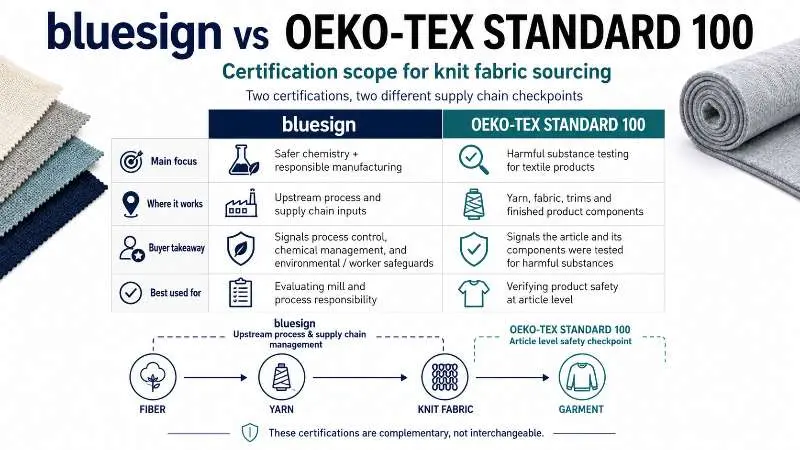
Bluesign is a process-based system that assesses the production process behind listed articles, including fabrics, accessories, and trims. OEKO-TEX® Standard 100 is a product-level harmful-substance testing system for textile articles, from yarn to finished product. They operate at different points in the supply chain and cannot substitute for each other. When a knit fabric supplier presents either certificate, buyers must verify the document scope matches the specific construction, colorway, and finishing route being ordered — not just the company or factory name.
When a knit fabric mill presents a Bluesign or OEKO-TEX® certificate, many brand buyers treat them as interchangeable sustainability credentials. They are not. One audits what goes into production; the other tests what comes out. Getting this distinction wrong means either over-trusting a certificate that doesn't cover your concern, or requesting the wrong document entirely — wasting time in a sourcing cycle where days matter.
Bluesign is a process-based certification system. For fabrics, the relevant claim is usually tied to a listed article: the fabric, accessory, or trim is identified as a Bluepass Article because the production process behind it meets Bluesign Criteria. For buyers, the key point is not whether the supplier has a general Bluesign-related document, but whether the exact article, construction, colorway, and finishing route can be verified.
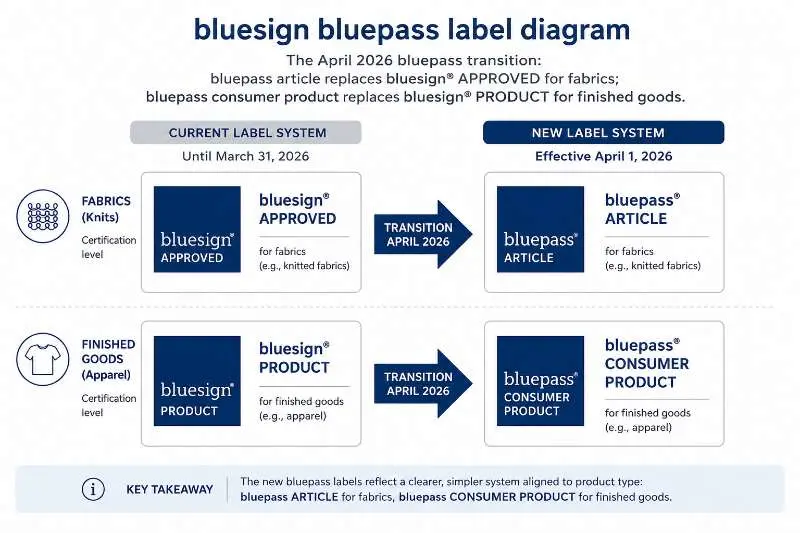
For knit apparel buyers — whether sourcing sportswear mesh, jersey, or structured double knit — a bluepass Article listing, or a legacy bluesign® APPROVED article listing during the transition period, signals that the production process behind that specific article has been assessed against bluesign Criteria. It does not mean:
A note on the 2026 BluePass label transition: From April 2026, Bluesign has been moving to a unified BluePass mark system. The underlying Criteria and on-site assessment process are unchanged; only the label names have been updated. For knit fabric articles, the relevant designation is now Bluepass Article (previously bluesign® APPROVED). Finished garments carry the Bluepass consumer product mark. When reviewing supplier documentation after April 2026, confirm whether the certificate uses the new bluepass terminology or a legacy bluesign® APPROVED label that remains valid where already in use.
OEKO-TEX® Standard 100 Tests the Textile Article — Not the Factory
OEKO-TEX® Standard 100 is a product-level harmful-substance testing system for textile articles, from yarn to finished fabric or finished product. In a knit fabric sourcing context, buyers usually use it to confirm whether the submitted fabric article has passed defined limits for substances such as heavy metals, formaldehyde, certain azo dyes, pH value, and other restricted chemicals.
For a knit fabric buyer, this means:
bluesign certified fabric vs OEKO-TEX® Standard 100: Scope Comparison
| Dimension | bluesign® (bluepass) | OEKO-TEX® Standard 100 |
|---|---|---|
| What it certifies | Manufacturing process (chemical inputs, factory environment) | Tested textile article(harmful substance levels) |
| Point in supply chain | Mill/production process | Yarn, fabric, garment, or accessory level |
| Test method | On-site facility assessment + ongoing audits | Lab testing of physical samples |
| Fiber content verification | ✗ | ✗ |
| Recycled content verification | ✗ | ✗ |
| Renewal | Continuous on-site audits | Annual re-testing |
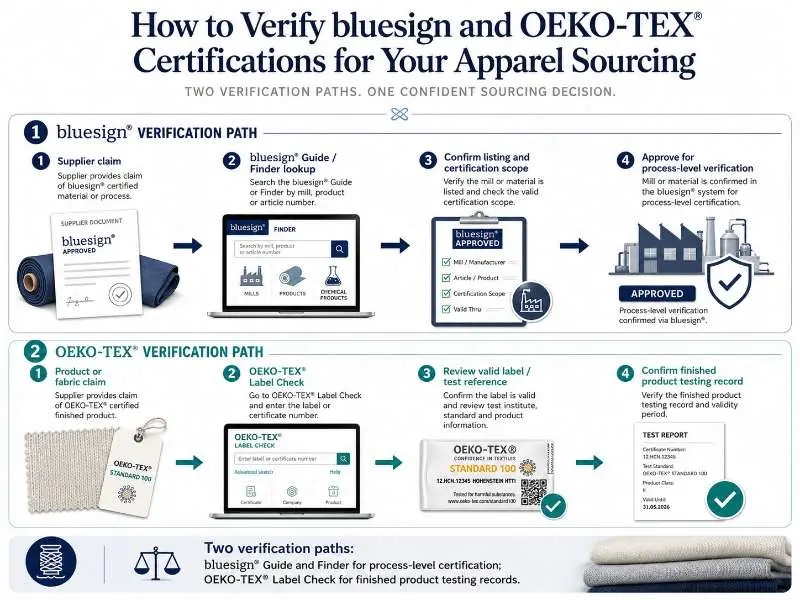
| Verification tool | bluesign Guide / Finder (bluesign.com) | OEKO-TEX® Label Check (oeko-tex.com) |
Certificate verification is not optional — expired documents, narrowly scoped approvals, and facility-level claims that don't extend to specific products are among the most common compliance gaps in knit fabric sourcing. The following steps apply before sampling, when the cost of a mismatch is still low.
For broader traceability documentation — chain-of-custody records, supplier audit trails, and material declarations — see our guide to textile traceability for knit apparel, which covers verification workflows beyond certification scope.
Neither Bluesign nor OEKO-TEX® Standard 100 addresses fiber origin or recycled content. If your product sustainability claims depend on what the yarn is made from — not just how it was processed — you need separate documentation. Two certifications are most relevant for knit apparel sourcing:
The practical buyer decision: certifications are not interchangeable, and stacking them does not compound the same claim. Before specifying which certifications you require from a mill, map your sustainability claim to the certification that actually covers it — fiber origin (GRS / GOTS), process chemistry (bluesign), or finished product residues (OEKO-TEX®). Demanding all four without a clear claim rationale adds cost and audit time on both sides without improving sourcing outcomes.
No. Bluesign is a process-based system for listed articles and production conditions, while OEKO-TEX® Standard 100 is product-level harmful-substance testing for textile articles from yarn to finished product. A fabric can hold one, both, or neither certification. They address different points in the supply chain, so buyers should verify the certificate scope, article listing, colorway, and finishing route before treating either document as coverage for a bulk order.
Use the bluesign Guide at bluesign.com/guide to search for specific fabrics listed as bluesign APPROVED — or bluepass articles as of April 2026. The Bluesign website also maintains a public list of system partner brands and mills. However, a supplier holding system partner status does not automatically extend that certification to every fabric they produce. Always verify that the specific construction and colorway in your order is individually listed in the Bluesign Guide before treating the supplier's partner status as coverage for your order.
Yes. The two certifications address different dimensions and are not in conflict. A mill operating as a Bluesign system partner may independently submit finished fabrics for OEKO-TEX® Standard 100 laboratory testing. Holding both provides coverage at the process level (Bluesign) and the finished product level (OEKO-TEX®), which is why brands with multi-claim sustainability programs — particularly those supplying EU and North American specialty retailers — often request documentation for both alongside GRS or GOTS where fiber content claims are involved.
Runtang Tex manufactures jersey knit fabric, mesh, and other knit constructions for apparel brands. OEKO-TEX® Standard 100 certified options are available. Please confirm certification requirements at the time of sampling and request documentation before bulk approval.
 Przewodnik po dzianinach
Dzianina welurowa: kierunek włosia, specyfikacja kroju i spójność koloru w produkcji seryjnej
CZYTAJ WIĘCEJ Dzianina
French Terry: wygodna dzianina, którą warto wypróbować
CZYTAJ WIĘCEJ Wskazówki producenta
Kontrola jakości dzianin dla marek odzieżowych: kontrola 4-punktowa i zatwierdzanie partii kolorystycznych
CZYTAJ WIĘCEJ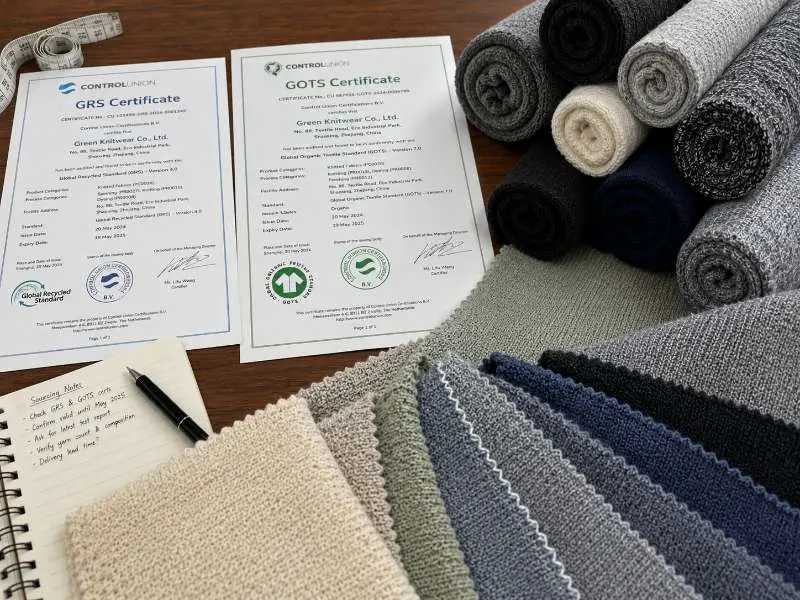 Zrównoważony rozwój
Ślad węglowy tekstyliów dla dzianin odzieżowych: co marki powinny śledzić przed produkcją wielkoseryjną
CZYTAJ WIĘCEJ Przewodnik po zaopatrzeniu
Tkaniny na odzież dziecięcą: struktury dzianin, normy bezpieczeństwa i kontrola próbek
CZYTAJ WIĘCEJ