Breistoffenfabrikant sinds 2009 · China
Breistoffenfabrikant sinds 2009 · China

Specifying a lightweight summer fabric for your knit collection involves more than setting a GSM target. Three structures — pointelle, knitted mesh, and bird's eye — each achieve breathability through different mechanisms, serve different end-use applications, and carry different risks at the sampling stage. Matching the right structure to the right brief before bulk commitment saves time and reduces rejection rates.
GSM tells you how much a fabric weighs per square metre. It does not tell you how it ventilates. Two fabrics at 150 GSM can perform very differently in warm weather depending on whether airflow moves through open holes, tuck-formed pockets, or a dense base with minimal ventilation. For summer knit apparel — tops, polo shirts, activewear panels — the structural logic of the fabric determines real-world breathability more reliably than weight alone.
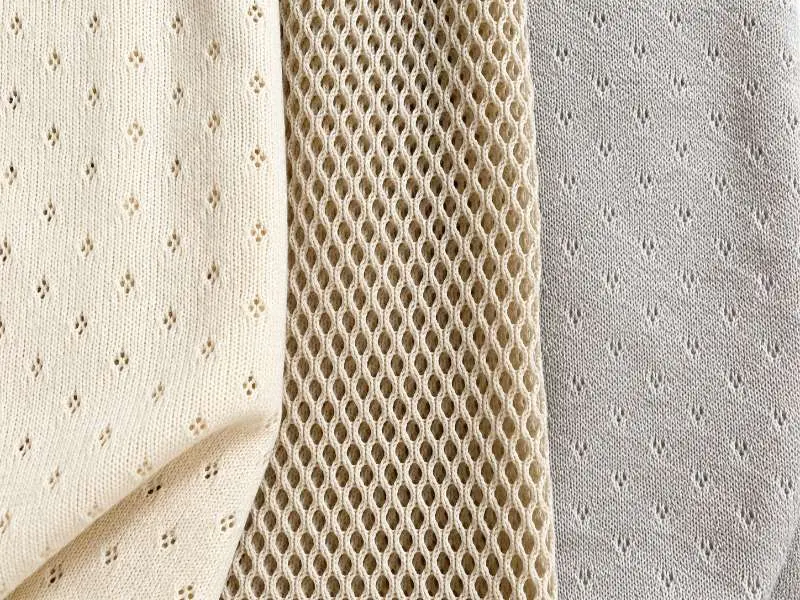
Pointelle achieves its airy hand through intentionally openwork voids in the knit construction. Knitted mesh creates continuous through-channels that allow direct airflow. Bird's eye uses a tuck pattern to form a surface texture with micro air pockets, without open holes. Each serves a different product category, and each requires different checks at the sampling stage.
Pointelle is a lightweight weft-knit structure with planned openwork areas across the fabric face. The result is a decorative, breathable surface suited to summer tops, layering knitwear, and lightweight apparel styles. GSM can vary by yarn, gauge, composition, and finishing, so buyers should confirm both weight and opacity during sampling. Runtang’s pointelle fabric range can be developed with different openwork patterns and composition options, including cotton blends and cellulosic fibre options, depending on construction feasibility and order requirements.
The primary sampling risk with pointelle is hole stability under wear and wash cycles. Openwork points are structurally weaker than the surrounding base knit, and yarn slippage or distortion at these points can change the fabric's hand and appearance after repeated laundering. Before approving bulk, request wash testing of at least three cycles and inspect the openwork pattern for dimensional consistency. Opacity is a secondary check — pointelle at lower GSM can be more sheer than expected, particularly in pale colourways.
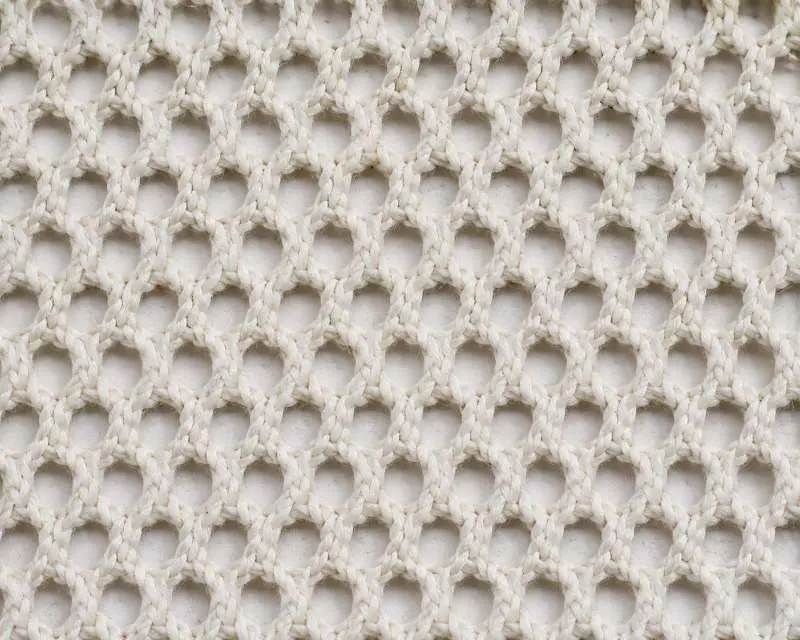
Knitted mesh creates open through-channels in the fabric structure, allowing direct airflow through the textile. Among the three options discussed here, it is usually the strongest ventilation choice for activewear panels, polo shirt inner panels, and lightweight performance liners. Runtang’s knitted mesh fabric is available in polyester and nylon base constructions, with Global Recycled Standard (GRS) certified options available for recycled polyester briefs. Please confirm certification requirements at the time of sampling.
The key sampling checks for knitted mesh centre on hole uniformity and stretch recovery where stretch is required. Hole size and pattern should be consistent across the full roll width and length — uneven tension during knitting produces variation that becomes visible in cut panels. If the brief requires elastane or mechanical stretch, request stretch and recovery data and confirm that the fabric returns to target dimensions after repeated extension. For sublimation-printed versions, confirm dye uptake consistency across the mesh surface, as open-channel structures can produce uneven colour density at print edges.
Bird’s eye is commonly produced as a tuck-textured knit structure with a regular raised-point surface. Unlike pointelle or mesh, it does not rely on open holes; instead, the tuck texture can provide moderate breathability while keeping a more stable hand. This makes it a practical option for polo shirts, corporate uniforms, and structured summer tops where appearance, dimensional stability, and ventilation need to be balanced. Runtang’s bird’s eye fabric is produced in polyester and polyester-cotton constructions, with GSM ranges depending on construction and finishing.
The primary sampling check for bird's eye is pattern regularity. The tuck-point repeat should be visually consistent across the width of the roll — any machine tension variation produces an uneven surface that becomes pronounced after garment construction. Polyester-rich bird’s eye can be suitable for sublimation printing. If that is in your brief, request a test print at the sampling stage and evaluate colour saturation and edge sharpness against your approved artwork.
The table below summarises the three structures across the dimensions most relevant to a summer knit sourcing decision.
| Structure | Breathability Mechanism | GSM Range (ref.) | Primary End-Use | Key Sampling Check |
|---|---|---|---|---|
| Pointelle | Openwork holes — patterned voids in the knit | 120–180 GSM, depending on construction and finishing | Summer tops, layering knitwear, feminine styles | Hole stability post-wash; yarn slippage at openwork points |
| Gebreid mesh | Through-holes — open channels for continuous airflow | 100–160 GSM, depending on construction and finishing | Activewear, polo shirt liners, ventilation panels | Hole uniformity across width; stretch recovery after repeated wear |
| Bird's Eye | Tuck pattern — structured surface pockets, not open holes | 130–180 GSM, depending on construction and finishing | Polo shirts, structured summer tops, uniforms | Pattern regularity across full roll; sublimation print compatibility |
Regardless of which structure you are evaluating, three checks apply across all lightweight summer knit fabrics before moving to bulk approval.
For a closer look at pointelle's openwork construction and what to evaluate before committing to bulk, see Pointelle gebreide stof: stabiliteit van opengewerkt breisel, garenkeuzes en wat je moet controleren vóór bemonstering voor bulk.
For summer knit apparel, a GSM range of approximately 100–180 GSM is generally considered lightweight, depending on construction and finishing. Pointelle and mesh structures often sit at the lower end of this range; bird's eye, with its double-knit base, can run slightly higher while maintaining an airy hand. The right GSM for your brief depends on end-use, opacity requirements, and garment silhouette — request samples across a range of GSM options before confirming.
Global Recycled Standard (GRS) certified recycled polyester options are available for knitted mesh and bird's eye constructions. Availability for specific constructions and compositions depends on the order specification — confirm GRS certification requirements and fibre options at the time of sampling.
Request a sample of pointelle, knitted mesh, or bird's eye knit to compare structure and GSM side by side before committing to bulk. Contact Runtang to get a quote or start a sampling request for your summer collection.
 Technische knowhow
Krimp en herstel van ribbreifabric: wat u moet controleren vóór bulkproductie
LEES MEER Inkoopgids
Welke stof strandkledingmerken eigenlijk moeten inkopen — en waarom de breistructuur alles verandert
LEES MEER Stof
Ontdek de verschillende soorten double knit-stoffen
LEES MEER Inkoopgids
Waarom uw stof voor slaapkleding na bulk blijft afkeuren
LEES MEER Technische knowhow
Krimp van wafelbreisel: wat kledingmerken moeten weten
LEES MEER