Breistoffenfabrikant sinds 2009 · China
Breistoffenfabrikant sinds 2009 · China

T-shirts are one of the most common end uses for jersey knit fabric, but they still create frequent sourcing mistakes when GSM, fiber composition, and shrinkage tolerance are not confirmed early enough. For apparel brands, these three checks should be handled before sampling is approved, not after bulk fabric has already been cut or dyed.
The GSM of jersey knit fabric affects more than physical weight. It influences cut yield, dye absorption depth, edge stability during cutting, and how the finished garment drapes and holds shape over time. For t-shirt production, the relevant range runs from around 130 GSM to 220 GSM, with the appropriate specification depending on garment category, end market, and construction method.
| GSM Range | T-Shirt Category | Common Fiber Options | Typical End Use / Buyer |
|---|---|---|---|
| 130–160 GSM | Lightweight / Athletic Tee | 100% cotton; cotton-polyester blend | Performance wear, warm-climate markets, summer collections |
| 160–185 GSM | Mid-weight / Everyday Tee | 100% combed cotton; cotton-modal blend | Casualwear basics, branded collections, retail channel |
| 185–220 GSM | Premium / Structured Tee | 100% combed cotton; cotton-bamboo blend | Premium basics, heavyweight retail collections, structured T-shirts, oversized silhouettes |
When specifying GSM for bulk orders, it is more practical to provide a target range — for example, 165–175 GSM — rather than a fixed number, since fabric weight can vary slightly between production lots. Our single jersey range covers multiple weight options across these tiers. Confirming the target GSM during sampling is the most reliable approach before committing to full-volume production. Brands considering a more stable double-sided alternative should also review single jersey vs interlock fabric — the structural difference affects both weight distribution and recovery.
Fiber Composition Checks Before Bulk T-Shirt Fabric Orders
Jersey knit fabric is produced in a range of fiber compositions, each with different implications for t-shirt production at scale. The most common options for bulk orders:
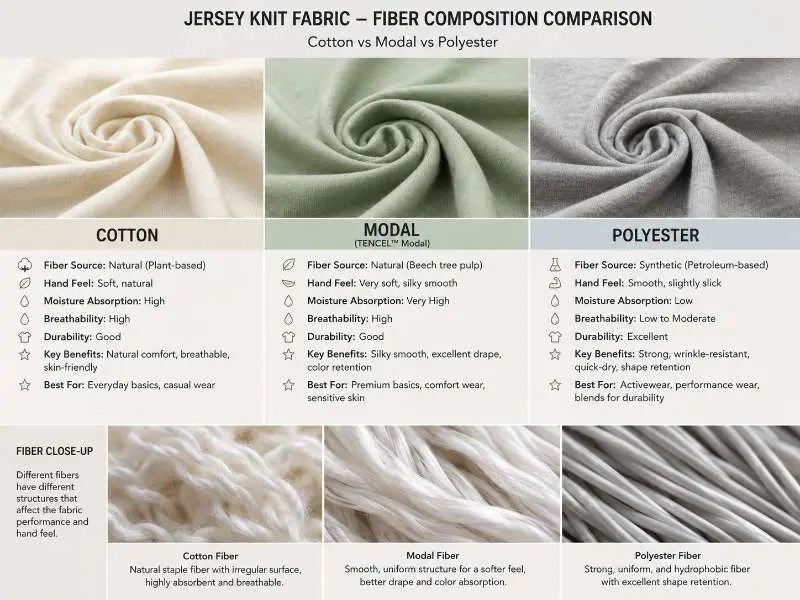
100% combed cotton — reliable dye uptake and consistent color across solid colorways. May show more dimensional change after washing compared to blended options, particularly without pre-shrink finishing treatment. Most widely used for everyday basics and retail-channel solid tees.
Cotton-modal blends — modal content may improve drape and hand feel. Pilling performance should still be checked through sample testing, since yarn quality, knit density, and finishing can affect the final result.
Cotton-polyester blends — polyester content can improve dimensional stability, but GOTS eligibility must be checked carefully. Virgin polyester is not permitted under GOTS fiber rules, while recycled synthetic fibers are subject to defined limits and certification conditions. Brands planning organic claims should confirm the exact fiber composition and certificate scope before sampling.
Cotton-bamboo (viscose) blends — may offer a soft hand feel and improved moisture comfort for selected T-shirt styles. For EU and North American markets, avoid labeling the fabric simply as “bamboo” unless the fiber claim is legally supported; use accurate fiber identification such as viscose or rayon made from bamboo where applicable.
For any custom fiber blend, a lab dip and pre-production sample should be reviewed before bulk approval. Buyers should confirm color behavior, hand feel, shrinkage tolerance, and testing requirements on the actual fabric specification rather than relying on fiber composition alone.
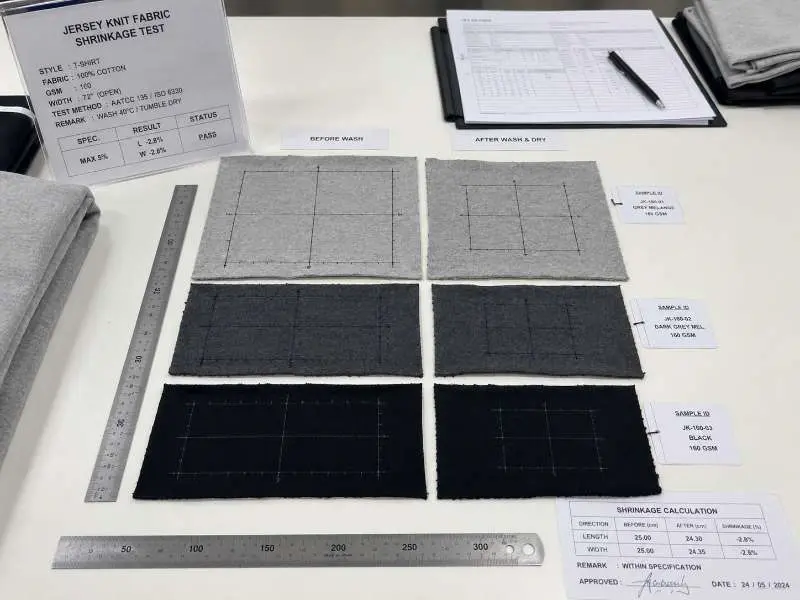
Jersey knit is a single-knit weft construction. Its loop structure can relax after washing, mainly in width but sometimes also in length depending on yarn, density, finishing, and fiber type. This is a predictable characteristic of the knit structure, and it is manageable when addressed at the fabric sourcing stage rather than after bulk cutting.
Key variables that affect shrinkage behavior:
For bulk orders, buyers should request shrinkage test data at the fabric sampling stage, specify acceptable dimensional tolerance in the tech pack, and confirm whether pre-shrink treatment has been applied before approving bulk production.
Certification requirements increasingly shape fabric sourcing decisions, particularly for brands supplying European and North American retail channels. The three certifications most relevant to jersey knit t-shirt fabric orders:
OEKO-TEX® Standard 100 — tests fabric for harmful substances across a defined list of chemicals, relevant to apparel end use. Applicable to both blended and single-fiber options. OEKO-TEX® Standard 100 certified options are available for selected jersey knit fabric orders. Certificate scope, product class, and validity should be confirmed before sampling.
Global Organic Textile Standard (GOTS) — applies to certified organic textile products and covers processing from organic fiber through finished fabric. For jersey knit T-shirt orders, GOTS eligibility depends on the certified organic fiber content, approved additional fibers, processing scope, and certificate coverage. Brands planning organic product claims should confirm the exact fiber composition and certificate scope before sampling.
Global Recycled Standard (GRS) — relevant for jersey knit orders incorporating recycled fiber content, such as recycled polyester or recycled cotton. GRS-certified material can support brands' recycled content claims in product labeling and marketing communications.
For orders requiring any of the above certifications, confirm requirements at the sampling and specification stage — certified material options may carry different minimum order quantities than standard production runs.
For everyday mid-weight t-shirts, 160–185 GSM covers the most common production range. Within that window, the lower end tends to suit lighter casual styles, while the upper range is more appropriate for structured or retail-channel basics. The target GSM should always be confirmed against the garment's design brief and verified on a pre-production sample before bulk approval.
Actual shrinkage tolerance depends on fiber composition, yarn, knit density, and finishing. For bulk T-shirt production, buyers should request test data from the sampled specification and define acceptable tolerance in the tech pack before cutting.
Yes, selected jersey knit fabric options can be supplied with OEKO-TEX® Standard 100 certification, depending on fiber composition, color, finishing, and order requirements. If your order also requires Global Organic Textile Standard (GOTS) or Global Recycled Standard (GRS) documentation, confirm the certificate scope before sampling. Certified options may carry different MOQ or lead time requirements from standard production runs.
Request a fabric sample for T-shirt production. Stock options start from 1 roll (~23 kg) per colour, and custom solid color development starts from 200 kg per color. Share your target GSM, fiber composition, color standard, shrinkage tolerance, and certification requirements to receive a matched sampling plan.
 Inkoopgids
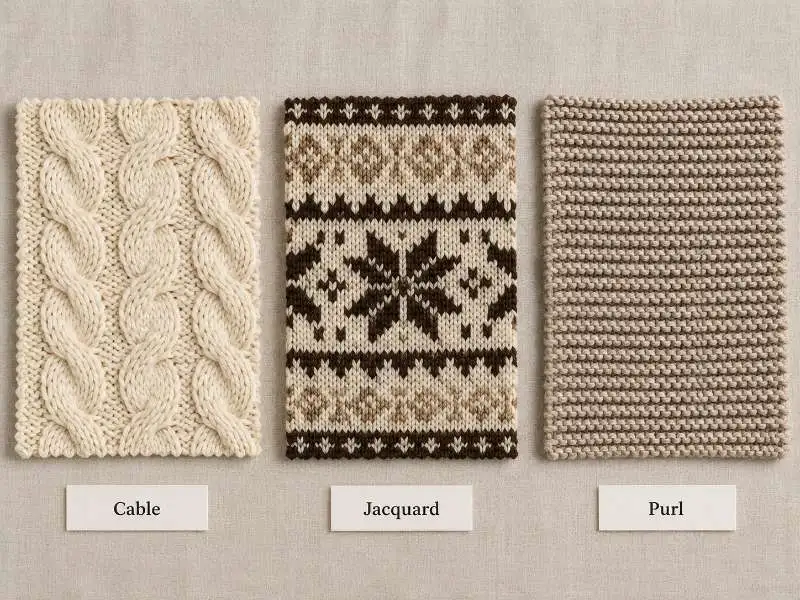
Beste stoffen voor sweaters: cable, jacquard en purl vergeleken voor bulkproductie
LEES MEER Branche-inzichten
Gebreide stoffen zijn voornamelijk gemaakt van vezels van welke samenstelling
LEES MEER Stoffengids
Velour breifabric: poolrichting, snijspecificatie en kleurconsistentie in bulk
LEES MEER Technische knowhow
Productieproces van double knit-stof
LEES MEER Inkoopgids
Welke stof strandkledingmerken eigenlijk moeten inkopen — en waarom de breistructuur alles verandert
LEES MEER