2009年創業のニット生地メーカー · 中国
2009年創業のニット生地メーカー · 中国

Most waffle knit rejections happen not at the design stage, but in bulk — when shrinkage runs over tolerance or cell structure flattens after washing. The spec that causes it was overlooked at sampling. This guide covers what sourcing teams need to lock down before committing to a bulk order: GSM range, cell depth behavior, and shrinkage verification.
Waffle knit fabric usually uses a knit structure that creates raised squares and recessed channels across the surface. These recessed areas, often described as cells, affect air retention, hand feel, and dimensional behavior after washing. Unlike interlock fabric, which has a smoother double-face surface, waffle knit has visible texture variation across the fabric face. For buyers, this means cell depth should be checked as a bulk quality variable, not only as a visual texture.
The structural consequence is significant for sourcing: cell depth is not a decorative variable — it directly affects how the fabric behaves under tension, in washing, and across a bulk run. A deeper cell structure generally means more yarn engagement per square unit, which influences weight, recovery, and — critically — shrinkage behavior. This is a different engineering logic from loop-based textiles like french terry, where the raised surface is a looped pile rather than a knit-in grid, and shrinkage dynamics differ accordingly.
For buyers, understanding this structural logic matters because it determines which spec questions to ask at sampling — and which variables to lock before bulk approval.
GSM in waffle knit fabric functions differently from flat knits of the same weight. Because the surface is three-dimensional, a fabric rated at a given GSM carries that mass across both the raised ridges and recessed channels — meaning the effective hand feel tends to read heavier than the number suggests. Depending on construction and finishing, waffle knit fabric typically falls within a mid-weight range, with lighter builds suitable for tops and base layers, and heavier constructions more appropriate for robes, loungewear sets, and outerwear-adjacent applications.
The practical decision point for sourcing teams is end-use performance, not weight alone. Consider three orientations:
For most apparel sourcing discussions, waffle knit is evaluated by relative weight band rather than one fixed GSM standard.
| Weight Band | Typical End-Use Direction | Key Sourcing Consideration |
|---|---|---|
| Lighter builds | Fitted tops, base layers, light casual | Shallower cell depth; confirm stretch recovery before bulk |
| Mid-weight builds | Loungewear sets, casual tops, pajamas | Balance of structure and drape; pre-shrink test essential |
| Heavier builds | Robes, bathwear, heavier casualwear | Higher shrinkage risk; batch yarn tension consistency critical |
GSM ranges vary depending on construction and finishing. If buyers are comparing waffle with interlock, rib, or French terry for relaxed sets, our loungewear knit fabric sourcing guide can help align GSM, opacity, recovery, and hand feel before sampling. Request lab dips and pre-production samples to confirm performance within your target range.
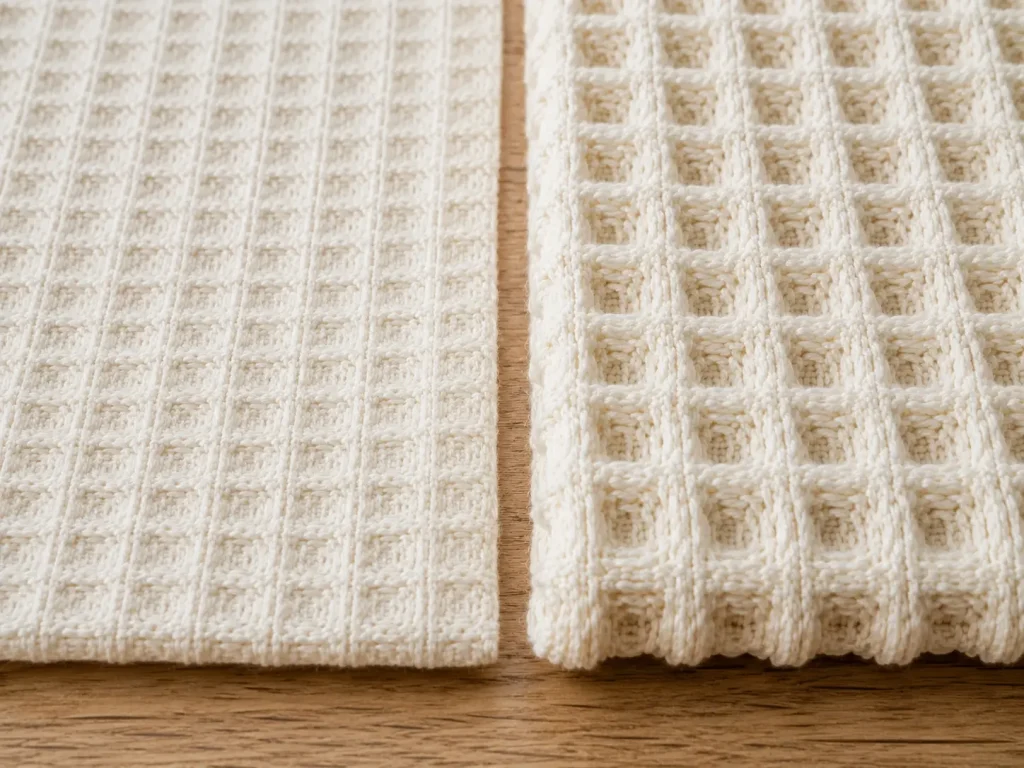
Shrinkage is the most common bulk rejection trigger for waffle knit fabric — and it is almost always traceable to decisions made before bulk production began. The cell structure that gives waffle knit its visual appeal is precisely what amplifies shrinkage risk: the recessed channels are maintained by yarn tension during knitting, and when that tension releases in washing, the cells pull inward. Cotton-based constructions are particularly susceptible, with untreated fabrics potentially losing dimension in both length and width on the first wash.
Two variables determine shrinkage outcome in bulk: pre-treatment consistency and yarn behavior. Pre-shrinking — running the fabric through controlled heat and moisture cycles before cutting — reduces residual shrinkage, but only if the process is applied consistently across the full roll length. Variation within a single roll can become a production risk in waffle constructions, because knitting tension and finishing consistency influence how evenly the cell structure relaxes after washing.
For fiber composition, cotton-dominant constructions carry the highest shrinkage exposure. Polyester-blended constructions offer better dimensional stability, though cell structure definition may be softer. Cotton-modal and cotton-spandex blends sit between these two positions and are common in mid-weight loungewear constructions — but spandex content introduces its own recovery variables that require separate verification.
OEKO-TEX® Standard 100 certified options are available. Please confirm certification requirements at the time of sampling.
The sampling stage for waffle knit fabric requires a tighter verification protocol than most flat-surface knits, precisely because the cell structure introduces more variables. The following checks are standard practice for sourcing teams placing bulk orders for waffle fabric production:
Custom development for waffle knit fabric — including GSM adjustments, fiber composition changes, and cell structure modifications — is available with a minimum order of 200 kg per color for solid custom orders. Stock options are available from 1 roll (~23 kg) per colour. Lead time for sampling is available on request.
GSM selection depends on the specific end-use and construction, so there is no single answer. Lighter-weight waffle knit tends to suit fitted tops and layering, while mid-weight constructions are more common for casual sets and pajamas. Heavier constructions are typically specified for bathrobes and applications where thermal mass matters. The more useful question before sampling is not just "what GSM" but what cell depth, fiber composition, and pre-treatment specification go with it — those variables determine how the fabric actually performs in production and end use. Request swatches across multiple GSM points within your target range and evaluate hand feel and shrinkage behavior together.
The most reliable method is to test according to the AATCC Test Method 135 (Dimensional Changes of Fabrics After Home Laundering) protocol or an equivalent standard, applied to swatches taken from multiple positions in the sample roll. Mark benchmark points on a measured specimen, wash according to the intended care procedure, dry as specified, and remeasure length and width separately. Calculate the length and width change separately. Run the test on at least two swatches from different roll positions to check for consistency within the sample. If results differ significantly between swatches, this indicates production tension variation that will scale in bulk. A third-party lab test of the pre-production sample is recommended for any order where dimensional tolerance is critical.
Request a sample or get a quote for custom waffle knit fabric development — including GSM specification, fiber composition, and cell structure requirements — through our waffle fabric product page or contact our sourcing team directly.