2009年創業のニット生地メーカー · 中国
2009年創業のニット生地メーカー · 中国

Key Sourcing Takeaways
Underwear fabric selection is one of the most specification-driven decisions in innerwear sourcing. The wrong construction choice — poor recovery, unstable surface, or unverified chemical safety — can result in returns, re-sampling delays, and compliance failures before a collection even reaches retail. This guide covers the three knit constructions most commonly specified for underwear, how their performance differs at the sourcing stage, and what skin-contact safety verification should look like in practice.
Most apparel fabric sourcing decisions balance handle, weight, and cost. Underwear adds a fourth variable that outerwear categories rarely demand at the same level: direct, prolonged skin contact. A fabric worn for long daily contact against sensitive areas cannot be evaluated the same way as a jacket lining or sweatshirt shell.
Three structural requirements distinguish knit fabric for underwear from other categories at the procurement stage:
These three requirements directly determine which knit construction is appropriate for which product type, which is where most sourcing decisions stall without clear structural data.
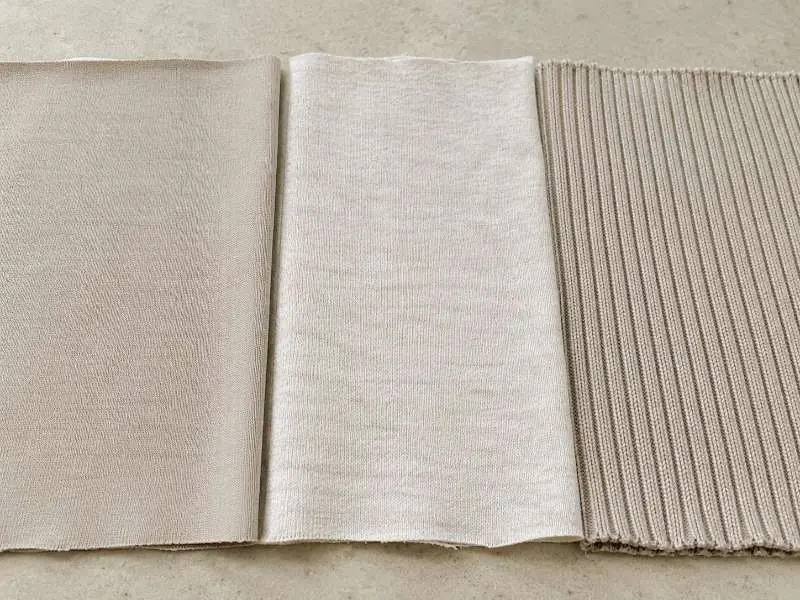
The three knit constructions most frequently specified for innerwear are interlock, single jersey, and rib knit. Each behaves differently under the performance requirements above, and the right choice depends on the specific underwear format being produced.
| 項目 | インターロック | Jersey | Rib |
|---|---|---|---|
| 組織 | Double-knit, smooth both sides | Single-knit, one-sided | Vertical rib loops |
| GSM direction | Typically 160–220 GSM | Often 130–180 GSM | Varies; lighter in fine-count |
| Stretch level | Moderate 2-way | Can support 4-way stretch with spandex | High lengthwise recovery |
| Surface stability | Higher stability when properly specified | Medium | Medium-high |
| Best for | Briefs, base layers, trunks | T-shirts, lightweight briefs | Waistbands, boxers, boyshorts |
インターロックニット is a double-knit construction with a smooth, stable surface on both faces. Because the two needle beds interlock the loops simultaneously, the resulting fabric resists curling at cut edges and maintains dimensional stability through repeated washing — making it well-suited to interlock knit fabric applications in briefs, fitted trunks, and base-layer tops where dimensional control matters. GSM for underwear-grade interlock can range depending on construction and finishing, but tends to sit in a heavier range than jersey for equivalent applications — a spec point to confirm at sampling.
Interlock knit fabric works particularly well for products that require a clean, smooth face against the body with minimal surface texture variation across the roll.
シングルジャージー remains the most widely specified construction for lightweight underwear — briefs, lightweight boxers, and layering pieces. Its characteristic one-sided knit produces a smooth face and a slightly looped back, with 4-way stretch (with spandex) that accommodates a wide range of body fits without custom sizing. Jersey's stretch performance depends significantly on spandex content: the actual percentage should be confirmed with the mill at sampling because it directly affects recovery after wear and wash.
The jersey knit fabric category spans a wide range of fiber blends — cotton/spandex, modal/spandex, and bamboo blends are common in innerwear — and GSM can vary significantly depending on construction and finishing. Specify the target end-use when requesting samples to ensure the mill aligns with the weight direction.
リブ編み — typically 1×1 or 2×1 construction — is defined by its vertical column structure, which gives it pronounced lengthwise stretch and strong recovery. In underwear, rib is most frequently specified for waistbands and cuffs, where recovery under tension is critical. Full-panel rib constructions appear in boxers and boyshorts, where a relaxed fit with shape retention is the brief.
The rib knit fabric category also accommodates spandex blends for added recovery — again, a parameter that should be specified explicitly rather than assumed from the construction name.
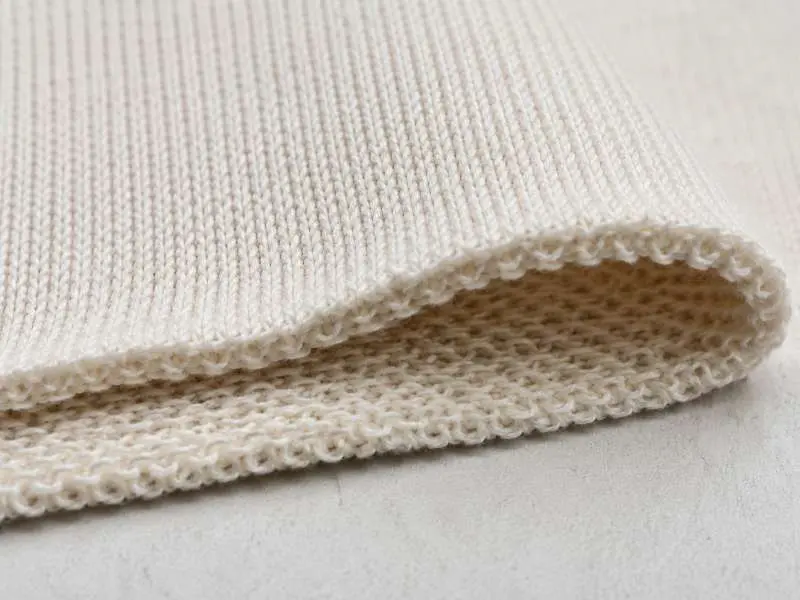
Stretch percentage and recovery rate are distinct measurements, and both matter in innerwear. Stretch tells you how far the fabric extends under tension; recovery tells you how completely it returns to original dimensions after that tension is released — and after repeated wash cycles.
For underwear sourcing, recovery is typically the more operationally significant number. A fabric can stretch generously and still fail quality inspection if it loses shape after repeated wash cycles. Recovery degradation is most commonly linked to spandex quality, spandex content percentage, and dyeing/finishing conditions — none of which are visible in a first-pass swatch review.
Sourcing teams should request documented stretch and recovery in knit fabric test results as part of the pre-bulk sample package, not solely the fabric specification sheet. Where brands have specific wash-durability requirements — common in performance innerwear and athletic base layers — these should be communicated to the mill at the sampling stage, not after bulk is approved.
Two additional construction variables affect innerwear stretch behavior and are worth confirming at sampling:
Chemical safety in skin-contact textiles is a procurement compliance requirement, not a marketing feature. Residual dyes, finishing chemicals, and fiber-treatment substances can cause contact dermatitis and skin reactions — a liability risk in the innerwear category that operates at higher exposure levels than most other garment types.
OEKO-TEX® Standard 100 is one recognised third-party framework for harmful-substance testing in textiles. Its product classes are based on intended use: Product Class I applies to babies and toddlers, while Product Class II applies to articles with direct skin contact, including adult innerwear.
Certified options are available. Please confirm certification requirements at the time of sampling. The full scope of the standard and tested substance categories is documented on the official STANDARD 100 page.
Practical steps for sourcing teams verifying skin-contact safety at the sampling stage:
GSM for underwear knit fabric depends on construction and end-use. Jersey for lightweight briefs typically sits in a lighter range; interlock for fitted trunks or base layers tends to run heavier. Specify your target end-use and desired hand feel when requesting samples — GSM direction should be confirmed by the mill based on the actual construction, as finishing and fiber content both affect final weight.
For skin-contact innerwear, request the current certificate or test report before bulk approval. Confirm that the product class matches the intended end use and that the document covers the exact construction, fiber blend, dyeing, and finishing route being ordered. Do not rely on a general mill certificate without checking the scope.
MOQ for custom solid-color knit fabric is 200 kg per color. Custom development orders (non-standard construction or fiber blend) typically have a 1,000 kg minimum. Stock fabric options are available from 1 roll (~23 kg) per colour for sample evaluation. Contact Runtang Tex at the sampling stage to confirm the MOQ for your specific construction and fiber requirements.
Runtang Tex manufactures knit fabric for underwear and innerwear across jersey, interlock, and rib constructions. Request a sample or get a quote with your target GSM, fiber blend, stretch requirement, and certification needs.