Cut and Mount
Specimens in length and width are sewn into tubes and mounted.
Knit Fabric Manufacturer Since 2009 · China

TEST METHOD · ISO 12945-1
ISO 12945-1 measures pilling after tumbling in a cork-lined box. Regular cotton knits measure grade 3 and above, and grade 4 is a very good result. US specifications often use ASTM D3512 instead.
ISO 12945-1:2020 (box)
ASTM D3512 / D4970
Grade 3+; 4 very good
1–5
Specimens on tubes are tumbled in a cork-lined box for an agreed number of revolutions, then compared with reference photographs in a viewing cabinet and graded from 5 (no pilling) to 1 (very severe).
The revolutions decide how hard the test is. Specifications we receive range from 7,200 to 14,400 revolutions, so a grade needs its revolutions next to it.
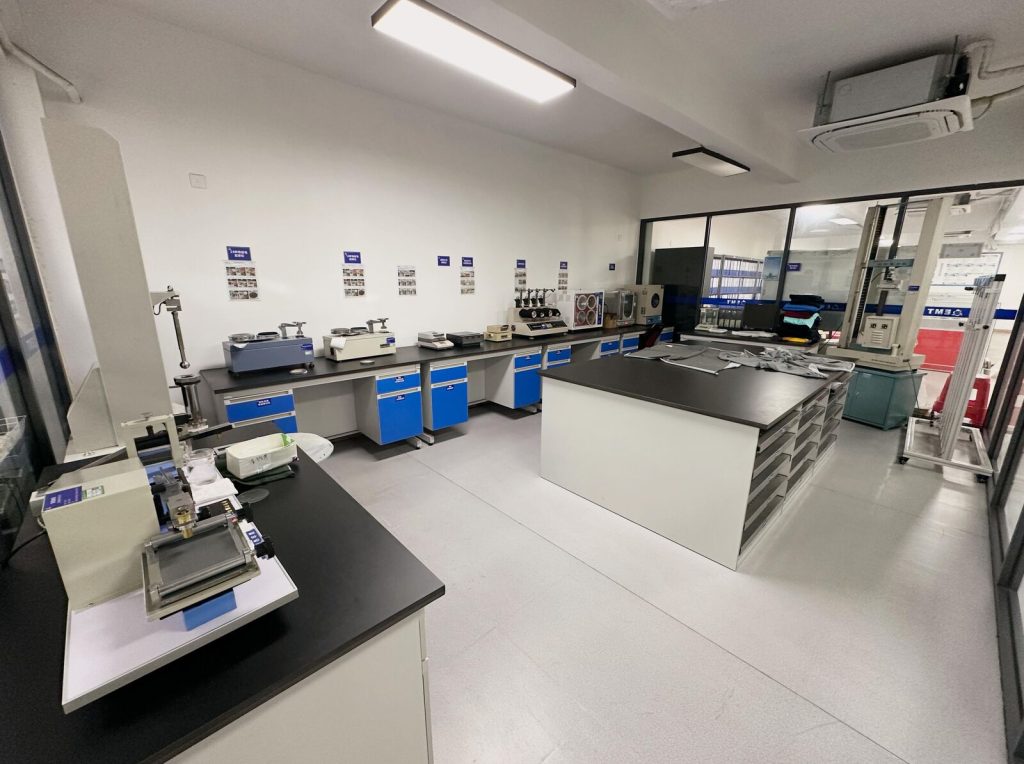
Our technicians follow a written work instruction for this method.
Specimens in length and width are sewn into tubes and mounted.
Tubes tumble in the cork-lined box for the agreed revolutions.
Specimens are compared with reference photographs in a viewing cabinet.
Each specimen is graded 1–5 by at least two technicians.
Key settings. Write the method and procedure in your specification.
| Parameter | Setting |
|---|---|
| Apparatus | Pilling box with cork lining |
| Revolutions | As agreed, e.g. 7,200, 10,800 or 14,400 |
| Evaluation | Viewing cabinet with oblique light |
| Grading | 5 = no pilling, 1 = very severe |
| Equivalent methods | ASTM D3512 / D4970 (US) · GB/T 4802.3 (China). Compare methods → |
Results depend on fibre, construction, shade and finishing.
| Fabric / shade | Our measured range | Values in buyer specifications |
|---|---|---|
| Regular 100% cotton knits | Grade 3 and above; 4 is very good | Grade 4 at 14,400 rev; 4-5 at 10,800 rev |
“Our measured range” comes from our own test records on bulk lots. “Values in buyer specifications” are requirements we have received; the value that applies to your order is the one written into it. — Xiwen Zhang, Co-founder & CEO
Write the grade with its revolutions, for example “grade 3-4 after 7,200 revolutions”.
Pilling box, random tumble (ASTM D3512) and Martindale give different grades.
Combed or compact yarns, enzyme bio-polishing and anti-pilling finishes can raise the grade. Ask before production.
For regular 100% cotton knits, grade 3 and above in ISO 12945-1 is generally acceptable and grade 4 is a very good result.
More revolutions mean more abrasion; the same fabric can be grade 4 after 7,200 revolutions and grade 3 after 14,400.
No. ISO 12945-1 uses a cork-lined pilling box; ASTM D3512 uses a random tumble tester. Grades are not interchangeable.