Nhà sản xuất vải dệt kim từ năm 2009 · Trung Quốc
Nhà sản xuất vải dệt kim từ năm 2009 · Trung Quốc

Key Sourcing Takeaways
Most sourcing briefs for beachwear specify fiber content — nylon/spandex or polyester/spandex — and stop there. That is not enough. The same fiber blend constructed as scuba knit versus knitted mesh versus a flat nylon jersey will produce fabric with meaningfully different stretch behavior, drying rates, and print compatibility. Brands that skip knit structure selection at the sampling stage often discover the gap only after bulk production, when fit inconsistencies or slow-drying complaints surface from end customers.
Nylon-spandex and polyester-spandex blends are commonly used for beachwear knits, and for good reason: both provide the stretch, salt resistance, and color stability that performance beach applications demand. But specifying fiber alone leaves the most consequential variable — construction — undefined.
Knit structure determines how the fabric behaves under tension, how quickly moisture escapes the surface, and how the fabric responds to printing or dyeing in bulk. A double-faced structure like scuba holds its shape under body movement but adds thermal mass. An open mesh structure accelerates airflow and moisture exit but trades surface uniformity for breathability. A flat single jersey delivers a lightweight, printable base but requires careful spandex content calibration to maintain recovery after repeated stretch cycles.
Sourcing teams evaluating fabric for beachwear should treat knit structure as a first-order decision, not a detail left to the mill.
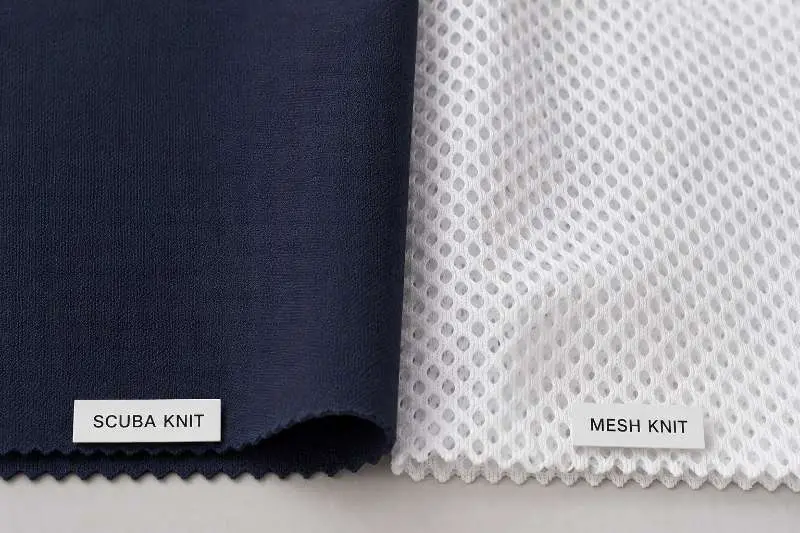
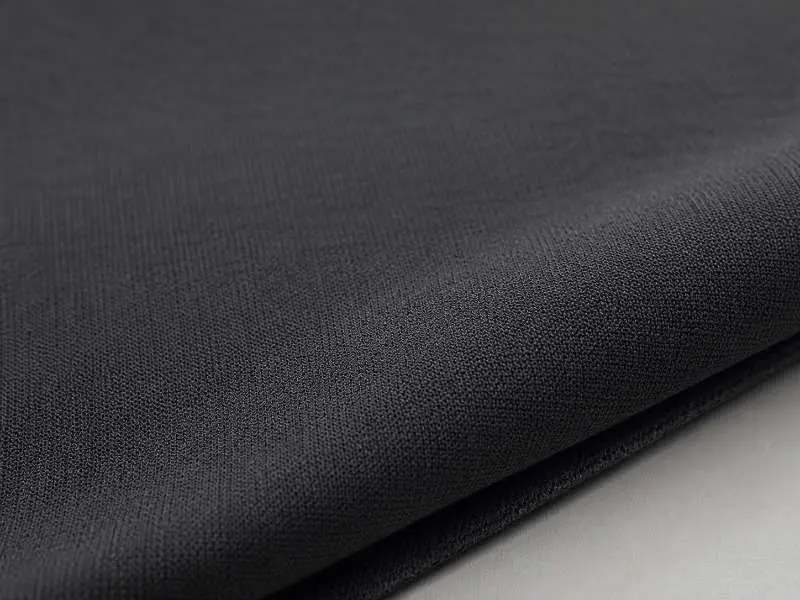
Scuba knit is a dense double-faced weft knit, often developed with polyester-spandex or nylon-spandex depending on the target hand feel, recovery, and printing route. For structured beachwear pieces such as one-piece silhouettes, fitted bikini tops, or resort dresses, the key advantage is dimensional stability rather than lightness.
From a bulk sourcing perspective, scuba’s density is both an asset and a constraint. The tight construction helps reduce surface variation between production rolls, which supports color and finish consistency across large orders. Polyester-rich scuba can also support sublimation printing more predictably than nylon-rich versions, while nylon-based options may be selected when stretch, drape, and color depth are more important.
The tradeoff is weight. Scuba knit for beachwear typically falls in the 200–280 GSM range, depending on construction and finishing. Brands targeting lightweight, packable resort pieces may find that weight works against the brief. For those applications, a lighter structure — mesh or a thinner nylon jersey — may serve better.
OEKO-TEX® Standard 100 certified options are available. Please confirm certification requirements at the time of sampling.
Knitted mesh is an open-loop structure with defined air channels running through the fabric face. For beachwear, that openness serves two functions: it accelerates moisture evaporation after water contact, and it allows airflow to pass through the fabric in high-heat coastal conditions.
These properties make knitted mesh fabric the preferred choice for beachwear categories that layer over swimwear — beach cover-ups, rash guards with ventilated panels, and resort overshirts. The quick-dry advantage is most pronounced when the mesh is constructed with a fine, consistent loop size: tighter loops maintain fabric integrity and print receptivity; larger loops maximize airflow but reduce structural stability.
For sourcing teams, the key specification to verify is hole size and loop uniformity across production rolls. In bulk manufacturing, mesh openness can shift slightly between dye lots if tension control is inconsistent. Request samples from multiple production rolls — not just from a single sample length — to confirm visual uniformity at volume.
Mesh also responds well to moisture wicking in knit fabric finishing treatments, which can be applied during the finishing stage to enhance performance for technical beach and resort applications.
For beachwear collections focused on resort use, fitted silhouettes, and saturated color palettes, nylon fabric remains a strong option. Nylon-based knits can support smooth stretch, close body fit, and deep dye results, especially when the brief prioritizes recovery, comfort, and visual color depth over heavy pool exposure.
The sourcing risk is chlorine. For garments expected to face frequent chlorinated pool use, do not treat nylon as automatically more durable than polyester. Instead, request chlorine resistance, colorfastness, and stretch recovery test results for the exact nylon-spandex construction being sampled. If the program targets swim schools, resort rentals, or repeated pool wear, polyester-rich or PBT-based constructions should be compared during sampling.
Cost should also be checked before range-wide adoption. Nylon-based beachwear fabrics may cost more than polyester options depending on yarn, dyeing route, and finishing requirements. For bulk orders, buyers should confirm both performance and price at the sample stage rather than choosing fiber content alone.
Specification sheets for fabric for beachwear list fiber content, weight, and stretch percentage. None of those figures tells you how the fabric will perform after the 30th wash, or how quickly it dries in a coastal environment, or whether the stretch recovery at the hip seam holds after a season of wear. Physical sampling and structured pre-production verification are the only ways to close that gap.
Three verification steps sourcing teams should complete before bulk commitment:
For orders involving sustainability requirements, confirm certification scope at the time of sampling rather than at order placement. Certification availability may vary by fabric type and production batch.
For structured swimwear pieces, scuba knit in the 200–280 GSM range is a common reference point. Mesh fabrics for cover-ups and ventilated layers typically run lighter. Exact GSM depends on construction and finishing, and may vary by batch — treat any figure as directional rather than a hard specification until confirmed against physical samples.
Yes, but the application logic differs. For fitted swimwear pieces, scuba's recovery and surface stability are strengths. For cover-ups where drape and lightweight hand matter, scuba's density can feel heavy relative to mesh or a fine nylon jersey. Brands building combined collections typically sample both structures separately and assign each to the appropriate product category rather than applying one fabric across the range.
Saturate a sample fully, wring at standardized pressure, and time the surface to reach a dry-touch state in ambient conditions. This simple benchmark reveals meaningful differences between fabric structures that specification sheets do not capture. Request samples from multiple production rolls and repeat the test to account for any batch variation before placing a bulk commitment.
Runtang Textile manufactures scuba knit, knitted mesh, and nylon-based knit fabrics for apparel brands across Europe, North America, and Australia. Request a sample or get a quote to begin your beachwear sourcing process.
 So sánh vải
French Terry và Fleece: Đọc bài này trước khi làm mẫu
ĐỌC THÊM Góc chia sẻ ngành
Khám phá đặc tính kỹ thuật của vải dệt kim Single Jersey
ĐỌC THÊM Góc chia sẻ ngành
4 Loại Chất Liệu Vải Quần Áo Quan Trọng
ĐỌC THÊM Vải
Vải Dệt Kim Jersey: Vải Dệt Kim Đơn cho May Mặc
ĐỌC THÊM Vải
Hướng dẫn toàn diện về vải Interlock: Đặc tính, ứng dụng và lợi ích
ĐỌC THÊM