Producent dzianin od 2009 · Chiny
Producent dzianin od 2009 · Chiny

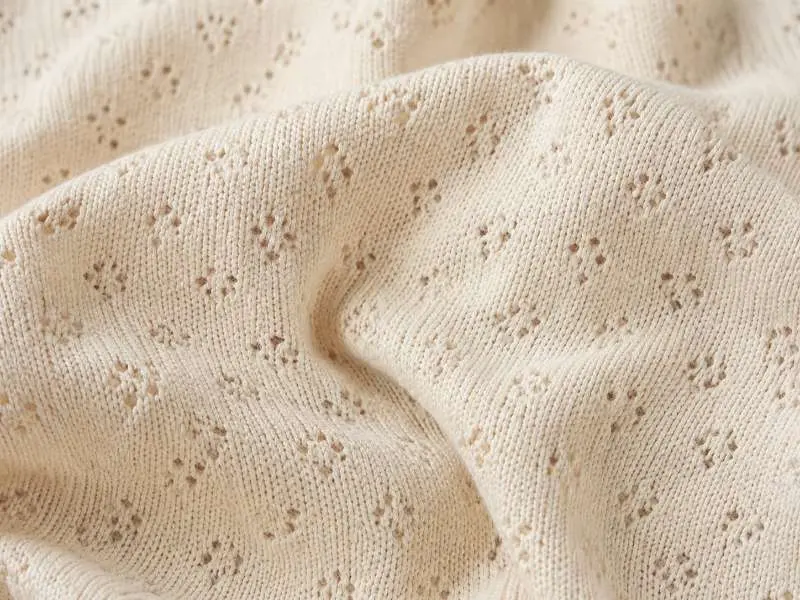
Pointelle knit fabric brings textured breathability to lightweight collections — but the same transfer-stitch structure that creates those geometric eyelets introduces specific risks in bulk. Hole deformation, dimensional growth after wash, and pattern inconsistency across fabric widths are the three issues that catch sourcing teams off guard. Locking these down at the sampling stage avoids costly re-orders.
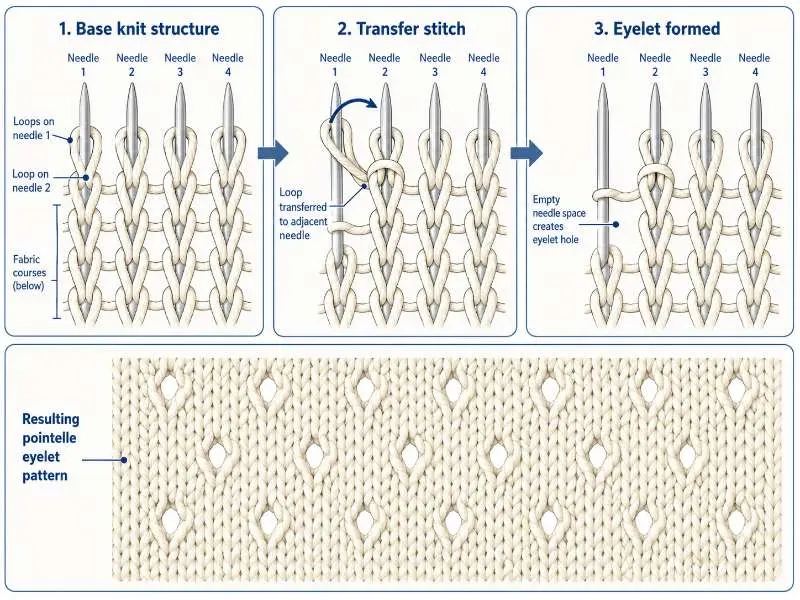
Pointelle's signature holes are usually created through transfer-stitch movement, where selected loops are shifted to adjacent needles to leave small eyelet openings. Depending on the design repeat and machine setup, jacquard-controlled needle selection can help control hole placement, size, and repeat accuracy across the fabric width.
The structural implication for buyers: pointelle knit fabric sits between a solid jersey and an open mesh in terms of stability. It has mechanical stretch from the open structure, but — unlike rib knit — it lacks the accordion pull-back that promotes recovery. A heavier yarn with no elasticity may allow holes to distort under tension, particularly in longer garments that hang under their own weight. Confirming machine gauge, pattern repeat, and needle-selection requirements with the mill before sampling helps reduce this risk.
Pointelle knit fabric typically runs lighter than most knit categories. Depending on construction and fiber blend, the working GSM range breaks into three bands:
One trade-off to note: higher GSM reduces transparency but can narrow eyelet openings, changing how the openwork pattern reads on the finished garment. If hole visibility is a design priority, GSM and needle selection need to be confirmed together during the sample brief — not treated as separate decisions.
For brands comparing openwork knits with other lightweight summer fabric sourcing options, pointelle should be evaluated by GSM, transparency, and recovery after washing.
Fiber choice in pointelle knit fabric directly shapes how the openwork behaves in wear and after washing. Three yarn paths cover most apparel applications:
100% bawełna — natural breathability and a clean hand feel. It is often considered for baby bodysuits and summer basics when shrinkage, safety, and fabric transparency requirements are confirmed during sampling. Cotton pointelle may require preshrinking treatment before cutting; shrinkage rates can vary depending on yarn count and finishing approach.
Mercerized cotton — depending on yarn quality and finishing control, mercerized cotton can offer a cleaner surface and better dimensional control than some standard cotton options. For pointelle end-uses where hole consistency through wash cycles matters, mercerized cotton knit fabric is worth testing at the sampling stage rather than assuming from the fiber name alone.
Cotton/spandex blends — spandex addition improves recovery, which is useful for fitted silhouettes like bodysuits and underwear. However, the spandex ratio in pointelle constructions needs to be controlled carefully: a high spandex percentage may cause the eyelets to partially close as the fabric recovers from stretch, altering the visual of the openwork pattern. The exact effect depends on construction and spandex percentage, so verification at the pre-sampling stage is essential rather than assumed.
For brands already working with jersey knit fabric as a base construction and considering pointelle as an upgrade, the fiber decision logic for blended constructions follows a similar framework — the openwork layer adds complexity rather than replacing the base spec.
These three checks apply before approving any pointelle knit fabric sample for bulk production:
Request a full-width fabric sample — not just a cut swatch. Pattern inconsistency between the selvedge and center can occur in jacquard-controlled openwork structures if tension and needle selection are not calibrated evenly across the needle bed. Check that the hole size, shape, and placement are uniform from edge to edge before approving the sample for grading.
Run a standard wash cycle on the sample before final approval. If eyelets elongate, distort, or begin to close after a single wash, the cause may be related to yarn selection, stitch construction, or finishing control, so it should be reviewed before bulk approval rather than left to downstream correction. This check is particularly critical for cotton/spandex-blended pointelle knit fabric, where the spandex recovery force interacts directly with the open stitch geometry.
Measure the sample before and after washing. Pointelle knit fabric may show different length and width shrinkage behavior from a solid jersey of similar GSM. Acceptable shrinkage tolerances depend on the garment spec — confirm what range the garment factory can accommodate before finalizing fabric approval, and align on pre-shrinking requirements if needed.
For women's tops and dresses, a pointelle knit fabric in the 150–200 GSM range is generally workable for most construction types. Below 150 GSM, transparency increases significantly, which may require a lining layer in the garment spec. Exact GSM recommendations depend on fiber blend and machine gauge — confirm at the sampling stage before committing to bulk quantities.
Stock pointelle knit fabric starts from 1 roll (~23 kg) per colour. For custom solid-color development, the MOQ is 200 kg per color. General custom development — including custom hole patterns or specified fiber blends — starts at 1,000 kg. Requesting a sample first to verify construction and finish before placing a bulk order is the standard workflow.
Ready to verify pointelle knit fabric construction before your next collection? Request a sample from our pointelle fabric range — or get a quote for custom development with your specified GSM and fiber blend.
 Dzianina
Tkanina pointelle: lekkie i przewiewne wzory z teksturowanym wykończeniem
CZYTAJ WIĘCEJ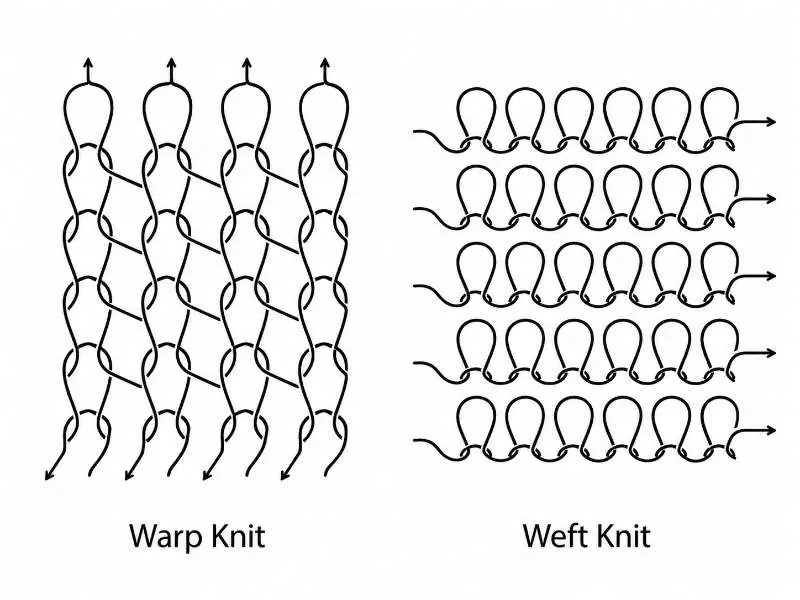 Know-how techniczne
Dzianina osnowowa a rządkowa: porównanie struktur trykotu, siatki i jersey dla odzieży
CZYTAJ WIĘCEJ Przewodnik po zaopatrzeniu
Tkanina na odzież do jogi i pilatesu: powrót do formy, miękkość i zachowanie rozciągliwości w produkcji masowej
CZYTAJ WIĘCEJ Dzianina
 single jersey vs dzianina interlock
CZYTAJ WIĘCEJ Przewodnik po zaopatrzeniu
Co kształtuje koszt dzianiny — i które zmienne możesz kontrolować
CZYTAJ WIĘCEJ