Producent dzianin od 2009 · Chiny
Producent dzianin od 2009 · Chiny

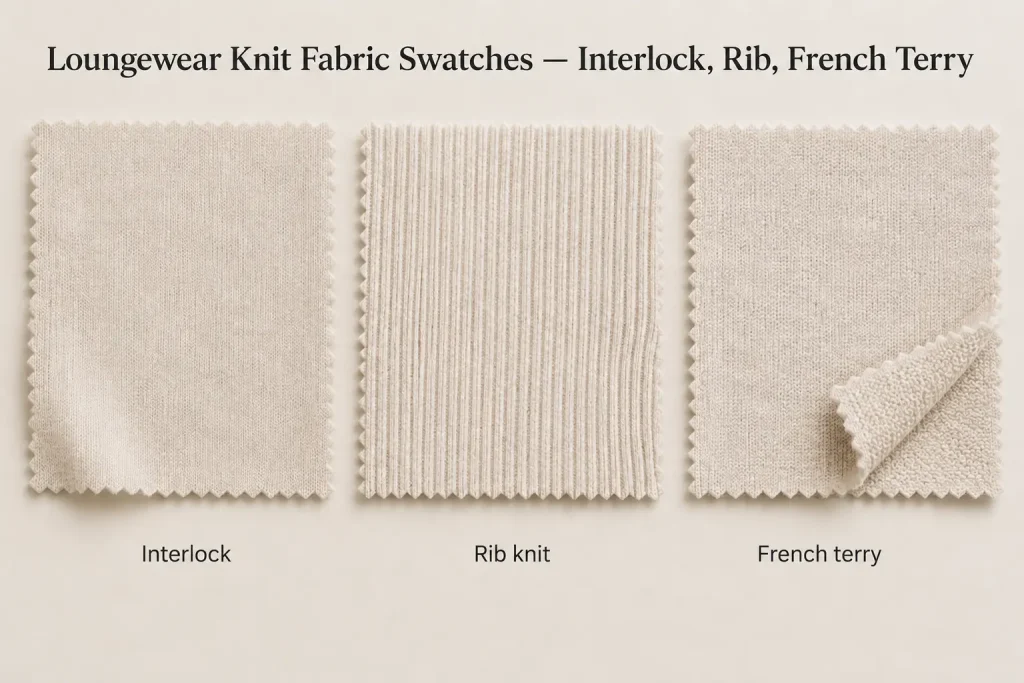
Three variables sink most loungewear development runs: the sample feels right but the bulk doesn't, garments bag out at the waist after a few wears, or the fabric goes sheer under studio lighting. Each failure traces back to the same decision point — choosing the wrong knit fabric for loungewear without verifying how it behaves at scale. This guide compares interlock, rib, and French terry on the three parameters that matter most before you commit to a production run.
Loungewear sits in a narrow performance window that activewear and basics don't share. The fabric needs enough body to avoid sheer failure, enough recovery to prevent bagging, and a surface hand that stays consistent wash after wash — not just in the sample room.
Before selecting a construction, verify three things on your sample:
These checks are straightforward on samples but vary significantly with fiber blend, finishing method, and even dye lot — which is why they need to be locked in as acceptance criteria before bulk, not discovered after delivery.
Interlock is a double-knit construction: two layers of interlocked rib stitches that produce a fabric with identical smooth faces on both sides. For loungewear, this matters for two reasons. First, the double-layer structure gives it naturally higher opacity than single-layer constructions at equivalent GSM — a practical advantage for fitted sets and jogger panels where sheerness is a quality concern. Second, its dimensional stability means cut pieces lie flat, seams hold cleanly, and the garment retains its shape through repeated washing without distortion at necklines or hems.
In terms of weight, interlock for loungewear tends to run on the medium to heavier side depending on construction and finishing — lighter builds suit fitted pajama tops and base layers, while heavier builds are appropriate for structured lounge sets. Always request samples across the GSM range your target end-use requires and wash-test before confirming bulk. OEKO-TEX® Standard 100 certified options are available. Please confirm certification requirements at the time of sampling.
Runtang's interlock knit fabric range covers cotton and cotton-blend constructions developed for apparel brands sourcing in bulk, with sampling available before production commitment.
Rib knit's vertical ribbing creates a fabric with significantly more horizontal stretch than interlock. For loungewear, this makes it the default choice for waistbands, cuffs, and necklines — but a growing number of brands are also using rib for full-body sets where that extended stretch is part of the product's identity.
The procurement risk with rib is recovery, not stretch. A rib construction that stretches easily but does not spring back fully can produce waistbands that bag out and sleeves that elongate after repeated wear. For internal screening, define a fixed stretch percentage, hold time, release method, and recovery measurement point before comparing rib samples. A construction with good recovery for loungewear should return close to its original dimension, but the acceptable threshold depends on the garment spec, rib ratio, gauge, and spandex content.
Spandex content, when present, generally improves recovery, but the fiber blend and knit gauge both affect the outcome — treat any percentage as a directional input, not a guarantee. Request wash-tested recovery data from your source before committing to bulk. Runtang's rib knit fabric options can be reviewed during sampling when recovery, gauge, and spandex content need to be compared for bulk orders.
French terry has a smooth face and a looped back — the loop structure is what creates its characteristic weight and hand. For loungewear, it's the most common choice for joggers, sweatshirt separates, and two-piece sets where a slightly heavier, textured feel is part of the brief.
Two procurement parameters matter here more than with the interlock or rib. First, loop height consistency: the loop structure determines hand feel, and variation in loop height across a bulk roll — or between dye lots — will produce noticeable hand differences between garment pieces. Ask for tolerance specs on loop height and request swatches from at least two lots before approving bulk. Second, bulk color consistency: the loop back absorbs dye differently from the face, which means shade variation between lots tends to be more visible on French terry than on flat constructions. Confirm your source's dye lot control process before placing large color runs.
Weight direction for French terry in loungewear applications is typically medium to heavy, depending on yarn count and construction — lighter builds suit summer-weight sets while heavier builds carry through to winter-adjacent product. For a closely related fabric option suited to loungewear cell-texture applications, Runtang's waffle knit fabric for loungewear covers GSM, cell size and shrinkage behavior in detail.
Runtang's French terry knitted fabric page includes available fiber compositions and sampling details for bulk programs.
The table below frames the key procurement dimensions side by side. Use it alongside physical swatches and wash tests — no table replaces handling the fabric.
| Dimension | Interlock | Dzianina ściągaczowa | French Terry |
|---|---|---|---|
| Opacity | High (double-layer) | Medium | Medium; depends on GSM and loop density |
| Recovery | Medium | Depends on spandex, gauge, and rib ratio | Medium |
| Primary use | Body panels, fitted sets | Waistbands, cuffs, full sets | Joggers, hoodies, sets |
| Bulk consistency | Wysoka | Medium–High | Medium (loop prone to variation) |
| Powierzchnia | Smooth both sides | Ribbed texture | Smooth face/loop back |
| GSM direction | Medium–heavy (depending on construction) | Light–medium (depending on construction) | Medium–heavy (depending on construction) |
A few practical notes on applying this table to a real sourcing decision:
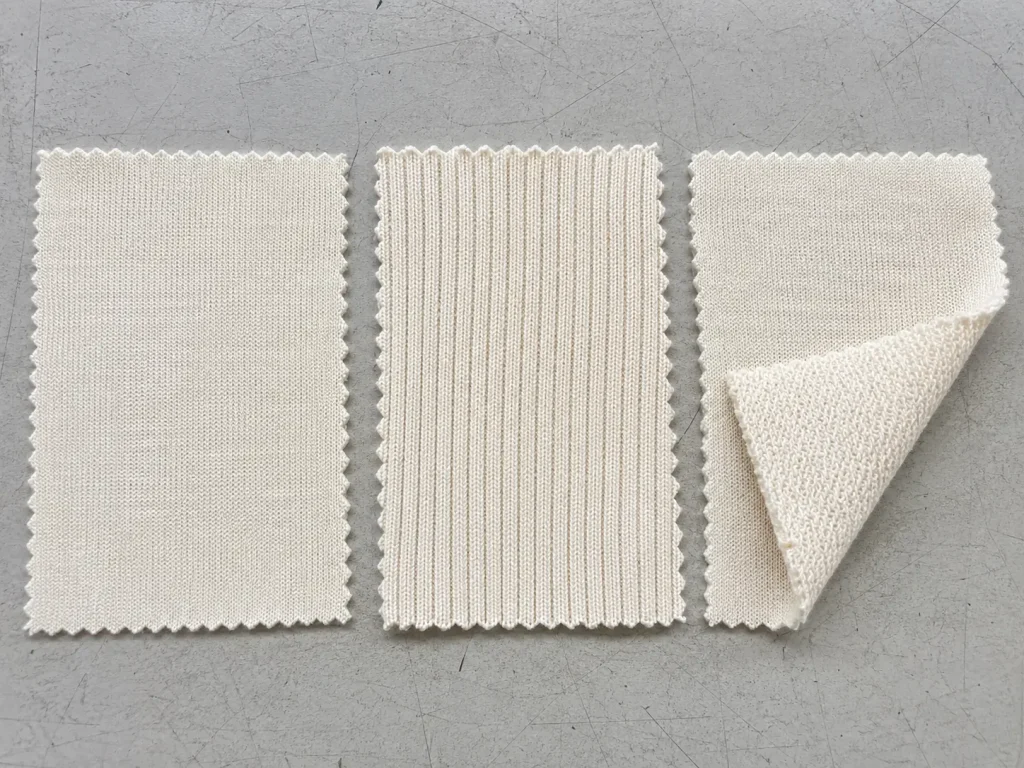
There's no fixed answer — the right GSM depends on the garment's silhouette, the season, and how much body you need the fabric to carry. A general direction: lighter interlock builds suit fitted pajama separates and base layers, while heavier builds are more appropriate for structured lounge sets or cooler-weather products. Request samples across a range and evaluate opacity, drape, and recovery at each weight before deciding on a bulk specification. Always wash-test before confirming.
Use a consistent backlight or light box, keep the sample distance and layer count the same, and compare washed samples at the exact GSM under review. For fitted loungewear, check both single-layer and stretched conditions. If available, ask your supplier for light-transmission or opacity screening data for the specific construction.
Runtang produces interlock, rib, and French terry fabrics for loungewear brands sourcing in bulk. Request a sample or get a quote to start the development process.
 Wiedza branżowa
Co można zrobić z bawełnianej tkaniny dżersejowej
CZYTAJ WIĘCEJ Dzianina
Gramatura tkaniny: przewodnik po doborze materiału
CZYTAJ WIĘCEJ Dzianina
 jersey: jednolita dzianina do produkcji odzieży
CZYTAJ WIĘCEJ Przewodnik po dzianinach
Tkanina żakardowa: misterna i luksusowa w Twoich tekstyliach
CZYTAJ WIĘCEJ Porównanie dzianin
Modal a dzianina bambusowa: prawda o certyfikatach, którą marki pomijają
CZYTAJ WIĘCEJ