2009년부터 이어온 니트 원단 제조사 · 중국
2009년부터 이어온 니트 원단 제조사 · 중국

Velour knit fabric is one of the higher-risk pile constructions in bulk apparel production. The same properties that give it visual appeal — a dense, sheared pile with directional sheen — are the variables most likely to produce shade inconsistency across a bulk order if cutting and dyeing specs are not locked at the sampling stage. This article covers what sourcing teams need to verify before approving fabric for production.
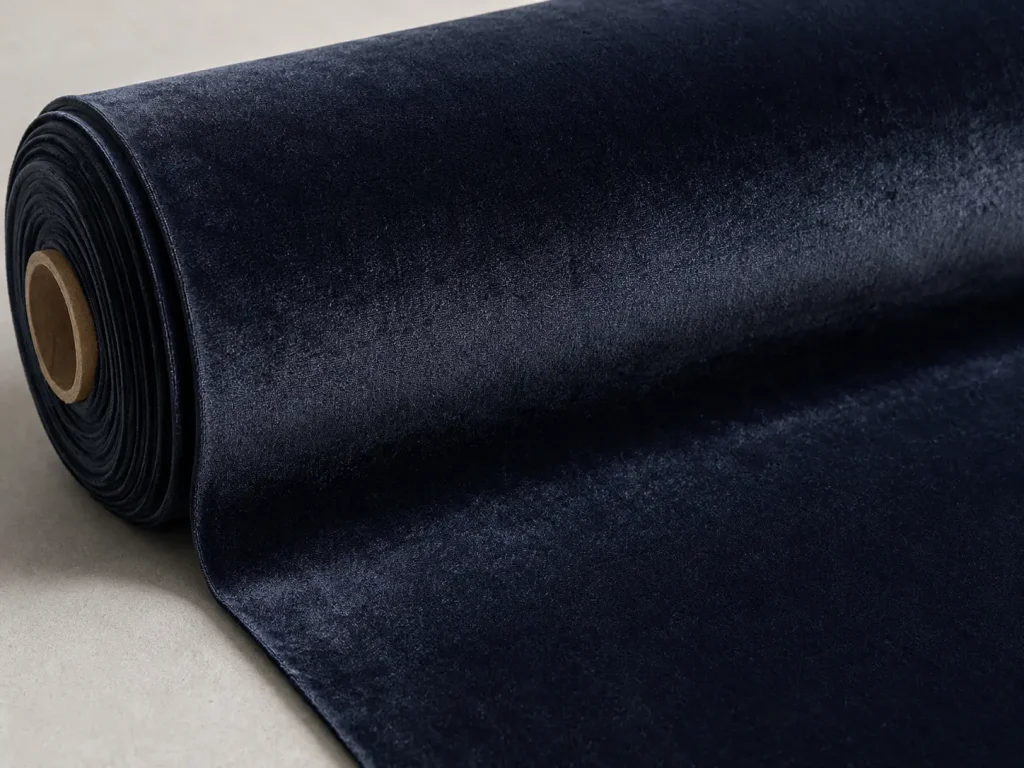
Velour is a cut-pile knit: a base fabric is knitted first, then a secondary set of yarn loops on the face side is sheared to create an upright pile surface. The ground knit provides the dimensional stability and stretch recovery you'd expect from a knit construction. The pile layer is usually short and sheared, but the actual pile height should be confirmed on the pre-production sample rather than assumed from fabric type alone.
This two-component structure is what separates velour from flat knits such as jersey knit fabric or interlock. Flat knits have a consistent appearance regardless of viewing angle. Velour does not — light hits the pile differently depending on direction, which is the root cause of the color-consistency challenges discussed below.
Fiber blends affect pile behavior. Cotton-dominant constructions tend to have more matte pile with higher absorbency, making them suitable for loungewear and robes. Polyester or polyester-spandex blends offer a shinier pile surface with better recovery, and are more common in athleisure and tracksuit applications. Blends may also include a small percentage of elastane to improve ground-knit recovery without affecting pile appearance significantly.
Runtang Textile manufactures velour knit fabric across fiber blend options for apparel brands in Europe, North America, and Australia. Request a sample via the Velour Fabric product page to confirm construction specs for your application.
GSM selection for velour should be driven by end-use requirements, not general preference. Higher GSM typically means denser pile, better thermal retention, and a more structured hand — suitable for outerwear-adjacent applications such as jackets or heavy loungewear sets. Lower GSM constructions offer lighter drape, more appropriate for fitted tracksuits or layering pieces.
Pile height influences sheen and pressure-mark sensitivity. Shorter pile produces a more uniform, matte appearance and is less likely to show handling marks during transit. Longer pile creates more visual depth and light contrast but requires more attention to packaging and folding direction during shipment.
When specifying velour for bulk, confirm GSM and pile height together — they affect each other. A construction may meet the GSM target while still having insufficient pile density to achieve the expected hand feel, depending on the yarn count and knitting parameters. Both should be measured and confirmed at the pre-production sample stage, not inferred from the initial lab sample alone.
Related pile constructions include chenille fabric and terry knitted fabric, which share the loop-pile base structure but differ in pile processing and end-use range. If your application requires absorbency over aesthetics, terry may be the more appropriate direction.
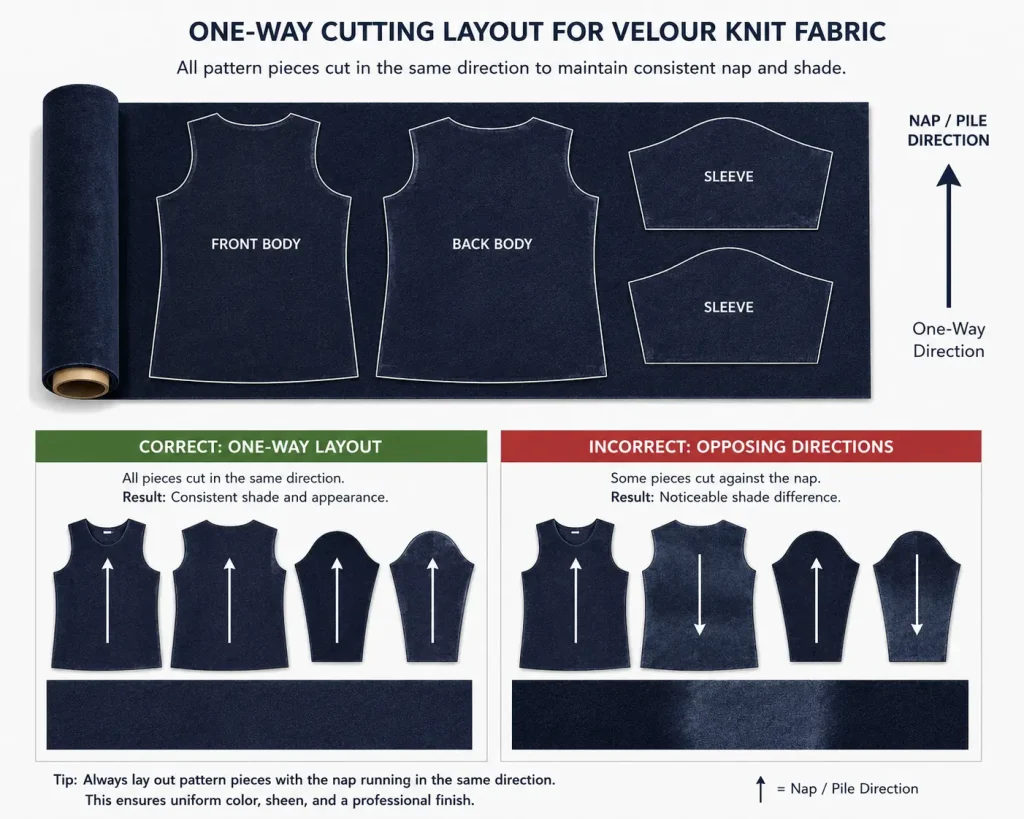
The pile of velour knit fabric naturally lies in one direction. When light hits the surface, fibers angled toward the viewer reflect differently than fibers angled away — producing a visibly lighter or darker shade depending on viewing angle. This is the nap shading effect.
In flat-knit production, cutting layout can be optimized freely to minimize fabric waste. With velour, cutting panels in opposing directions — a common factory shortcut to improve fabric yield — will cause adjacent garment panels to reflect light differently, making a single-color garment appear two-toned under normal lighting. This is one of the most common reasons velour garments show visible panel-to-panel shade differences after cutting.
The specification that prevents this is a one-way cutting layout: all pattern pieces must be cut with the pile running in a single, consistent direction across the full garment. This requirement must be written explicitly into the Tech Pack — it cannot be assumed. Without it, cutting decisions are left to production-floor discretion.
What to include in your Tech Pack spec for velour cutting:
For broader nap-direction control across pile constructions, see our guide to nap direction in pile knit fabric.
Velour presents a specific dyeing challenge that flat knits do not. The pile structure creates vertical fiber clusters that resist full dye penetration at the base. If post-dyeing washing and soaping are not controlled consistently, unfixed dye may remain near the pile roots. The lab dip can still appear acceptable, but the bulk fabric may show color transfer during rubbing or wash-related checks.
Before approving bulk fabric, request a wet crocking test on the actual bulk fabric — not just the pre-production sample. A damp white cotton cloth rubbed against the velour surface can help identify surface dye transfer before shipment. For dark colors such as navy, black, and deep burgundy, this check should be treated as a required bulk-approval step. For formal color transfer evaluation, sourcing teams can refer to AATCC TM116 for colorfastness to crocking when discussing rubbing-test requirements with suppliers.
Additional color-consistency checks to build into your bulk approval process:
GSM selection depends on garment weight and end-use. Lighter tracksuit constructions typically use lower GSM ranges suitable for fitted, unlined pieces, while heavier loungewear sets or outerwear-adjacent applications call for higher GSM with denser pile. Confirm the target GSM with your factory at the sample stage, as pile height and ground-knit density both affect the final measurement — GSM alone does not fully characterize the construction.
Include a dedicated cutting direction note in the fabric specification section of your Tech Pack. State the required pile direction (typically pile-down for apparel), require one-way layout for all panels, and note the expected fabric yield adjustment. If your garment has multiple panels with different grain orientations, specify the pile direction for each panel type. Requesting a pre-cutting layout diagram from the factory before cutting begins is a reasonable checkpoint for first-time velour orders.
Screen printing on velour is more difficult than printing on flat knits because the pile can interrupt ink coverage and pressure may flatten the surface. For many bulk orders, embroidery, woven appliqué or heat-transfer patches are easier to control, but the final decoration method should be tested on the approved bulk fabric.
Runtang Textile manufactures velour knit fabric for apparel brands in Europe, North America, and Australia. Request a sample or contact us to discuss pile spec, GSM range, and certification requirements for your next production run.