2009年創業のニット生地メーカー · 中国
2009年創業のニット生地メーカー · 中国

A pile knit fabric can pass every lab test and still generate color complaints after bulk delivery. The cause is rarely a dye problem — it is misaligned nap direction during cutting. For velour, chenille, and terry knit, a single inconsistently oriented panel in a cutting lay changes how light hits the pile surface. The result looks like a shade variation, but the fix is in the cutting spec, not the dye room.
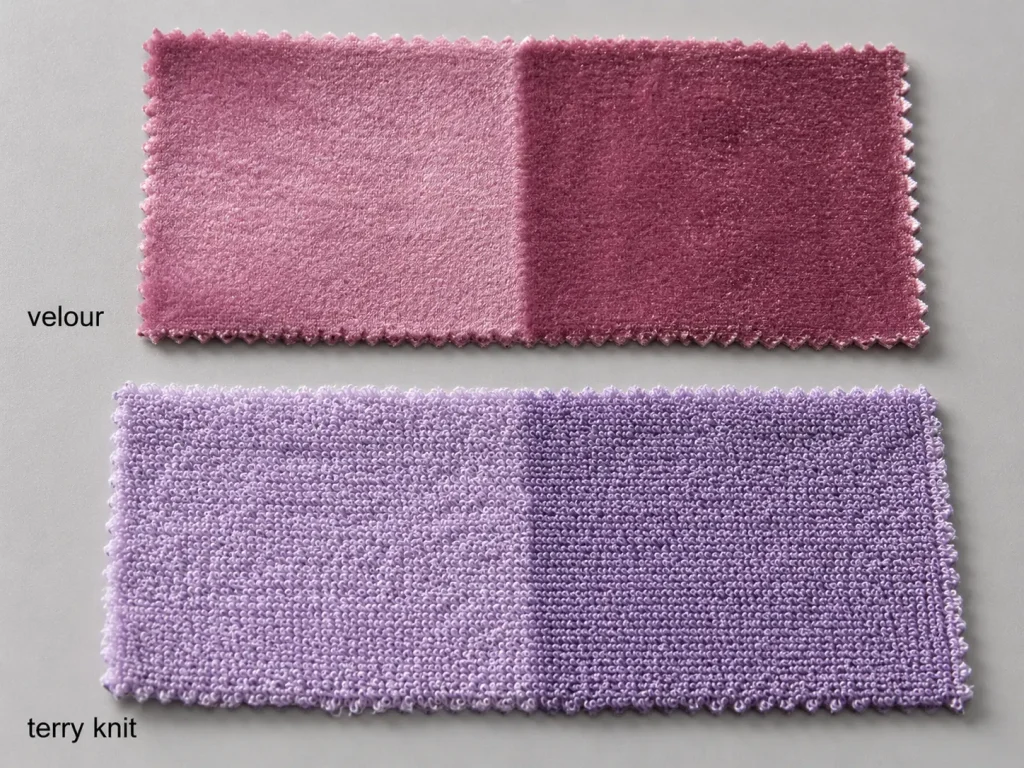
Pile knit fabrics — velour, chenille, and terry — have raised fibers or loops that reflect light directionally. When the pile points toward the viewer, light scatters across the fiber tips and the fabric appears lighter in tone. When the pile points away, light travels along the fiber shafts and the fabric reads deeper and richer. This optical shift is called shading, and it is one of the most consistent QC failure modes in pile knit garments.
In a bulk cutting room, the risk compounds quickly. A cutting lay can contain hundreds of garment pieces across multiple stacked fabric plies. If some plies are reversed — placed with pile running in the opposite direction to reduce marker waste or improve nesting efficiency — the cut panels from those plies will shade differently in the finished garment. Two sleeves cut from the same delivery roll can look like they came from different colorways. No colorimetry reading and no shade card approval will prevent this if the cutting direction is not specified before production starts.
This is why nap direction must be treated as a cutting specification, not an informal convention. For brand buyers sourcing pile knit fabrics, the point to confirm this protocol is during tech pack review — before the cutting room opens the first roll.
Not all pile knit fabrics carry the same shading risk. The degree to which nap direction affects color readability depends on pile type, pile height, and fiber surface characteristics. The comparison below reflects general production patterns; specific values may vary depending on construction and finishing.
| 生地 | Pile Structure | Nap Intensity | Shading Risk in Bulk |
|---|---|---|---|
| Velour | Cut pile (sheared loop) | 高い | High — one-way cutting required |
| Chenille | Twisted pile yarn | Medium | Medium — one-way cutting strongly recommended |
| テリーニット | Uncut loop | Low to medium | Lower — increases with heavier GSM and structured styles |
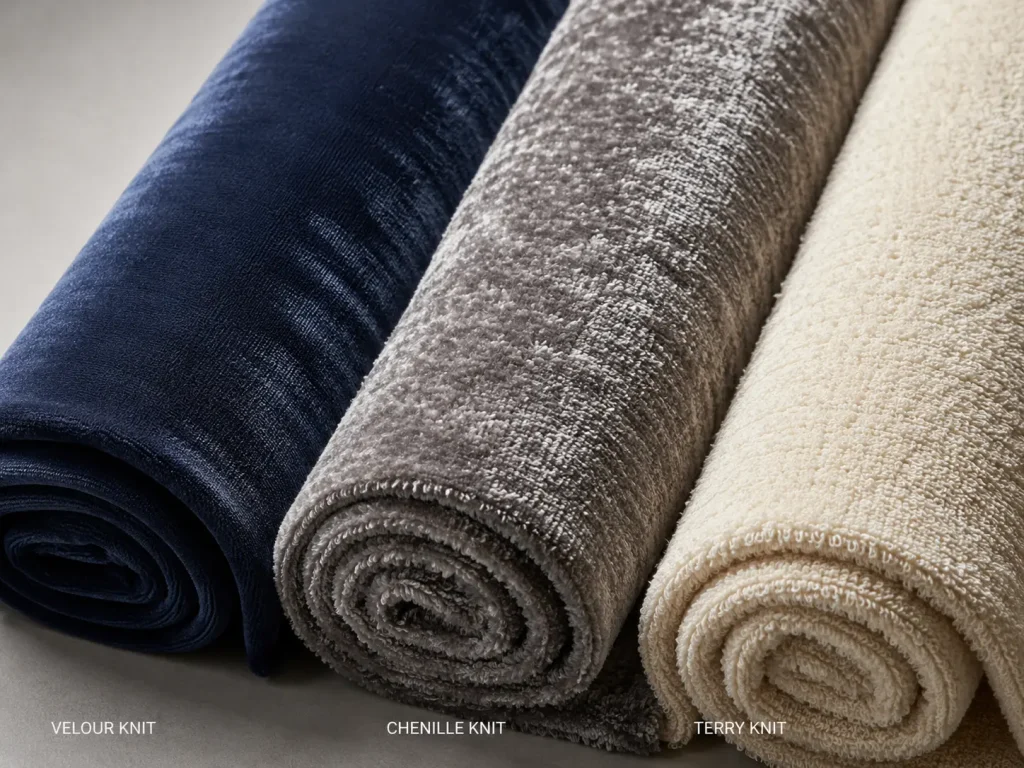
Velour carries the strongest nap effect of the three. Many knitted velour qualities are produced by shearing a looped knit surface, releasing fiber ends into an upright cut pile. These freed tips scatter light sharply in one direction and absorb it in the opposite. Pile height can vary depending on construction and finishing; taller piles generally produce a more pronounced shading differential between orientations. For more on velour knit pile direction and available fabric specifications, one-way cutting is the baseline production requirement — not an optional precaution.
Chenille fabric presents a moderate nap effect. The pile is formed by twisted chenille yarns arranged in a caterpillar-like structure. When the pile leans in the fabric feed direction, color can appear slightly deeper; reversed, it reads lighter. The shading differential in chenille fabric is less extreme than velour but still registers clearly in assembled garments, particularly across large panels such as front bodies or sleeves where the shade contrast is most visible at a distance.
Terry knit (uncut loop) has the most forgiving nap profile of the three. The uncut loops create a more diffuse pile surface that distributes reflected light in multiple directions. However, terry knitted fabric does carry a directional bias — the loop openings tend to face one end of the fabric in the knitting direction. Under certain light angles, this can register as a subtle color shift. For heavyweight constructions or structured garment styles where color uniformity is a specification requirement, one-way cutting is still the recommended approach during pre-production.
The practical consequence of specifying nap direction is a cutting mode called nap-one-way (N/O/W). In an N/O/W marker, every pattern piece is oriented in the same direction across the full fabric width. This restricts how efficiently pieces can be nested and, in most pile knit styles, increases fabric consumption compared to a non-directional nap-either-way (N/E/W) marker.
The cost implication is real. N/O/W cutting usually increases consumption compared with a non-directional marker because pattern pieces cannot be freely rotated. The exact difference should be confirmed through marker calculation before bulk fabric booking. For pile knit styles, this should be treated as a planned yield variable rather than a post-approval cost surprise.
When specifying pile knit fabrics in a tech pack, the cutting direction instructions should include:
Providing these specifications to the cutting contractor at the start of production eliminates the most common and preventable cause of shade variation in pile knit garments.
Before committing to bulk on any velour, chenille, or terry knit order, the following four checks reduce the risk of shading issues at the delivery stage:
At Runtang, velour, chenille, and terry knit samples are dispatched with nap direction clearly marked. Pile spec confirmation is part of the pre-production communication for all pile fabric orders.
Terry knit has a less pronounced nap than cut-pile fabrics, but the loop structure still carries a directional bias. For lightweight terry in solid colors, the visual impact may be minimal and some factories treat it as N/E/W. For heavier constructions — or structured garment styles where color uniformity is a written specification — one-way cutting is the recommended default. Confirm the cutting mode with your production team during tech pack review, particularly for styles with large single-piece panels.
Include: pile fiber content and pile height direction (general orientation, not an absolute value), marker mode specified as N/O/W, preferred pile orientation on the finished garment (pile-up or pile-down), and an instruction to the cutting contractor to mark and bundle cut pieces by nap direction before distribution to sewing lines. For chenille, also specify the viewing axis for shade approval — whether the shade card is evaluated with the pile running toward or away from the light source. Confirm this with your fabric contact during the sampling stage so the same reference condition is replicated at bulk.
A dyeing defect shows a measurable color difference on a spectrophotometer regardless of how the fabric is oriented. Nap-related shading is directional — the same panel reads lighter or deeper depending on how it is held relative to the light source. Color evaluation can be referenced against AATCC test methods and evaluation procedures, including instrumental color measurement and visual color difference assessment. However, nap-related shading still requires production-side cutting control because the same fabric may read differently when pile orientation changes. The fastest diagnostic is to hold the disputed panel under directional light and rotate it 180°. If the shade shifts, the cause is likely nap direction rather than the dye batch. Planning a velour, chenille, or terry knit order? Request a nap-marked sample or get a quote with pile direction and cutting spec confirmed before bulk production.
Planning a velour, chenille, or terry knit order? Request a nap-marked sample or get a quote with pile direction and cutting spec confirmed before bulk production.