Knit Fabric Manufacturer Since 2009 · China
Knit Fabric Manufacturer Since 2009 · China

Key Sourcing Takeaways
The direct answer: warp knit fabrics use multiple yarns running vertically, locking loops diagonally to produce stable, run-resistant structures with limited stretch. Weft knit fabrics use a single continuous yarn running horizontally, creating loop chains that give in multiple directions. Tricot and warp-knit mesh sit in the first camp; jersey, rib, and interlock sit in the second. Which structure your order calls for depends on whether the priority is dimensional stability or garment-forming elasticity — and that decision shapes everything from cutting layout to QC specification.
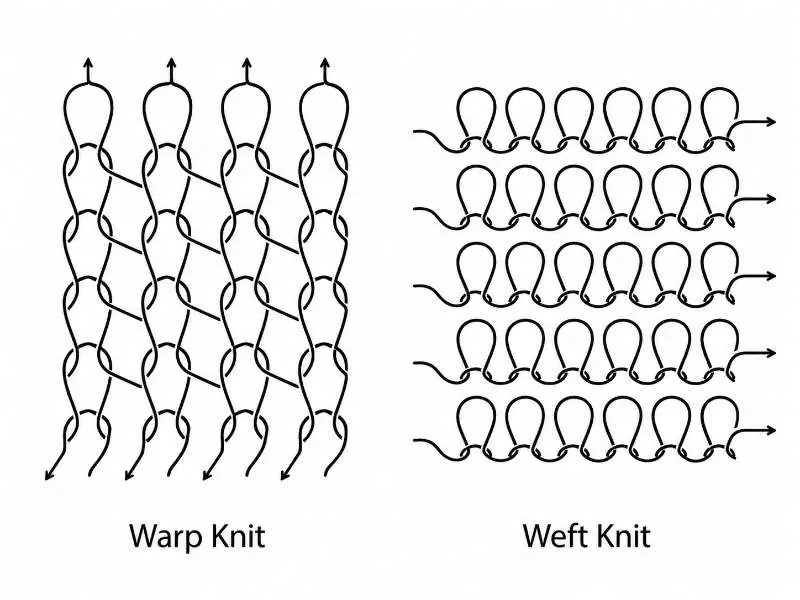
In warp knitting, hundreds of parallel yarns are fed simultaneously from warp beams. Each needle receives its own yarn, and all needles form loops together in a single pass. The loops interlock in a diagonal, chain-link pattern — a structure that holds dimensionally: it resists unraveling, does not extend significantly in the vertical direction, and maintains shape under repeated stress. This is why warp knit is the go-to structure wherever fabric stability matters more than stretch range.
In weft knitting, a single continuous yarn — or a limited number of yarns — travels horizontally across the needle bed, forming one course (row) at a time. Loops interlock in the horizontal direction, which is the source of the weft knit's signature stretch: pull the fabric sideways and the loops open; release, and they return. Add spandex and the recovery becomes elastic in all directions. This construction is what makes jersey feel body-conforming and rib is selected when repeated stretch recovery is required, such as cuffs, collars, and waistbands.
Structure comparison at a glance:
| Property | Warp Knit | Weft Knit |
|---|---|---|
| Yarn direction | Multiple yarns run vertically, looping diagonally | Single yarn runs horizontally, looping back and forth |
| Primary stretch direction | One-way (horizontal) | Two-way or four-way (with spandex) |
| Dimensional stability | High — resists distortion and run-through | Lower — loops can unravel if a yarn breaks |
| Edge behaviour when cut | Stable, minimal curl | May curl; handling care required |
| Typical fabric types | Tricot, raschel, warp-knit mesh | Jersey, rib, interlock, french terry, fleece |
| GSM range (indicative) | 60–220 GSM depending on construction | 100–500+ GSM across fabric types |
| Common apparel application | Lining, swimwear, activewear shell, compression | T-shirts, hoodies, leggings, polo shirts, base layers |
The two warp-knit structures discussed here are tricot and warp-knit mesh. Both share the structural characteristics of warp knitting — stability, run-resistance, and limited vertical stretch — but mesh construction should still be confirmed before sampling because mesh fabrics can be produced in different knit structures.
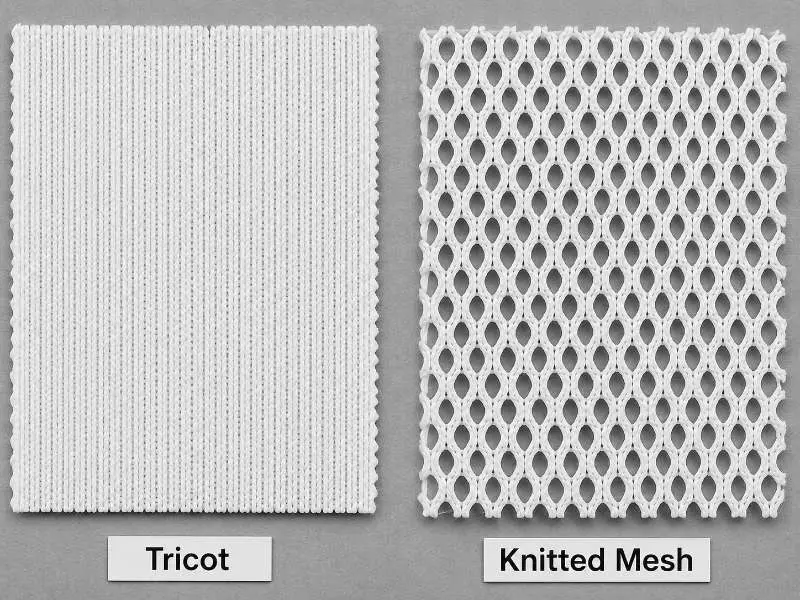
Tricot features fine vertical wales on the face and horizontal ribs on the back. Its tightly interlocked loop structure makes it run-resistant and dimensionally stable across production runs — the reason it has become the default fabric for sportswear and outerwear linings, intimate apparel, and swimwear underlayers. A tricot fabric lining does not distort under the outer shell during wear or cutting, and its smooth face reduces friction against the body.
Tricot is most commonly produced in nylon or polyester. Denier count governs weight and opacity: lighter constructions (may include 30D–40D range, depending on construction and finishing) suit lining applications where a low-profile, smooth underlayer is required; heavier options deliver more body for structured outerwear components. Because tricot stretches primarily in the horizontal direction, pattern grading and cutting layouts must account for the fact that the fabric will not extend significantly in the vertical direction — a mistake at this stage creates fit problems at bulk production that no finishing adjustment can correct.
For sourcing teams receiving a brief that specifies tricot: confirm stretch direction, denier or GSM target, fiber content, and whether any surface finishing (anti-static, moisture-wicking coating) is required. These parameters should be locked at swatch approval, not left open until bulk fabric delivery. A dedicated tricot lining fabric specification for sportswear applications will typically also require confirmation of one-way stretch percentage and dimensional stability under washing conditions.
The knitted mesh discussed here is a warp-knit mesh, with controlled open spaces formed by separating loops at defined intervals. The open construction creates breathability without sacrificing the run-resistance inherent to warp knit. Knitted mesh is common in activewear ventilation panels, sports bra underlayers and side inserts, and technical outerwear components where weight reduction is a specification requirement.
GSM in knitted mesh varies considerably depending on hole size and yarn density. When sourcing knitted mesh for performance applications, request the open area percentage alongside GSM — this figure determines actual airflow performance. Two mesh fabrics with identical GSM but different cell sizes will deliver measurably different breathability results in production garments.
Weft knit structures account for the majority of knit fabric volume in commercial apparel production. The horizontal loop construction gives every weft knit fabric its defining stretch characteristic — the variable is how much stretch, in which directions, and with what recovery behavior.
Single jersey is the foundational weft knit structure. Its continuous horizontal loop chain produces a fabric with a smooth knit face and a looped or purl back. The structure stretches in both directions, with greater width stretch than length stretch in basic constructions; adding spandex shifts it to four-way stretch with elastic recovery. Jersey knit fabric is the standard for T-shirts, casual tops, and performance base layers. GSM range spans lightweight options for warm-weather applications through to heavier constructions for structured knitwear — depending on yarn count, stitch density, and fiber blend.
Rib knit alternates knit and purl loops in vertical columns, producing a fabric with prominent vertical ribs and strong elastic recovery. The balanced tension between alternating columns gives rib its characteristic return-to-shape behavior across repeated stretch-recovery cycles — which is why rib is the standard choice for cuffs, neckbands, waistbands, and any garment component that must maintain its original dimensions after sustained wear and washing. Rib ratio (1×1, 2×1, 2×2) affects both the rib prominence and the degree of elastic recovery; the appropriate ratio should be confirmed with the manufacturer at the sampling stage.
Interlock is a double-face weft knit constructed by interlocking two rib layers. The result is a heavier, more dimensionally stable fabric than single jersey: smooth on both faces, reduced curl at cut edges, and better production consistency across roll-to-roll variation. Interlock is the standard fabric for polo shirts, infant apparel, and body-contact performance garments where both surface uniformity and dimensional consistency across bulk production runs are specified. ASTM D8007-24 covers wale and course count measurement for weft knitted fabrics, including jersey, rib, and interlock categories, while excluding warp knits such as tricot and raschel. For interlock sourcing, this means loop density, dimensional change, GSM, and shrinkage tolerance should be declared before pre-production approval.
For all weft knit fabrics, the core sourcing parameters are GSM, fiber composition (including any spandex percentage), shrinkage tolerance, and loop density consistency. These should be confirmed at swatch approval and revalidated at bulk fabric inspection — weft knit fabrics can show roll-to-roll variation when yarn feed, stitch density, finishing tension, or shrinkage control is not consistent, and that variation can affect both cutting yield and garment fit in production.
The choice between warp and weft knit structures is not a matter of preference — the application specifies it. The table below maps common garment requirements to the appropriate knit construction and the sourcing logic behind each.
| Garment Requirement | Structure to Source | Why |
|---|---|---|
| Stable, non-stretching lining inside outerwear | Warp knit — tricot | Smooth face, one-way stretch will not distort outer shell shape |
| Ventilated performance panel or insert | Warp knit — warp-knit mesh | Open structure with run-resistance in high-movement zones |
| Full-body stretch and athletic fit | Weft knit — jersey + spandex | Four-way elasticity, body-conforming loop structure |
| Collar, cuff, or waistband with recovery | Weft knit — rib | Elastic return to original width after repeated stretching |
| Stable double-face base for structured apparel | Weft knit — interlock | Reduced edge curl, higher GSM consistency than single jersey |
| Compression layer for activewear | Warp knit or weft knit (spandex-heavy) | Confirm stretch percentage and compression class at sampling |
In practice, many technical garments — particularly in sportswear and outerwear — use both warp and weft knit components within the same style. A running jacket may combine a weft knit jersey body, a warp knit tricot lining, and warp knit mesh ventilation inserts. Each component requires its own specification sheet, its own sampling stage, and its own quality check before bulk production approval.
When a production brief includes both warp and weft knit requirements in a single style, treat them as entirely separate sourcing decisions. Stretch direction, cutting layout, GSM tolerance, shrinkage expectations, and certification requirements may all differ between the two fabric types — even when they appear in the same garment. Conflating them at the specification stage is one of the most common sources of mid-production rework in knit apparel manufacturing.
A note on certifications: warp knit fabrics used in activewear and swimwear — particularly polyester-based tricot and mesh — are increasingly requested with Global Recycled Standard (GRS) certification when they contain recycled fiber content. OEKO-TEX® Standard 100 applies to both warp and weft knit fabrics where skin-contact safety is required. Neither certification is exclusive to one knit type; the certification requirement is determined by the fiber content and the end-use application, not the knit construction.
Tricot is a warp-knit fabric. It is produced on warp knitting machines where multiple yarns run vertically and interlock diagonally, creating a dimensionally stable structure with one-way stretch in the horizontal direction. This distinguishes it from jersey and other weft-knit fabrics, which use a single horizontal yarn and offer multi-directional stretch. When a tech pack specifies tricot lining, the sourcing team is specifying a warp knit — and must confirm stretch direction and denier before pattern grading.
Warp knit — specifically tricot — is the standard choice for activewear lining. Its dimensional stability prevents the lining from distorting under the outer shell during movement, and its smooth face reduces friction and moisture drag against the body. Tricot lining is sourced in nylon or polyester, with denier count selected based on weight, opacity, and any functional finishing requirements. Weft-knit fabrics are rarely used for performance lining applications due to their tendency to stretch and distort in multiple directions.
Warp-knit fabrics can be dyed and printed, but the process must be confirmed based on fiber content and surface construction. Polyester-based tricot and warp-knit mesh are commonly specified for sublimation printing, while nylon constructions usually require a different dye system confirmed by the dyeing mill. For mesh, the open cell size can affect print edge definition, so strike-off approval is necessary before bulk production.
Runtang Tex manufactures tricot fabric, warp-knit mesh, and jersey knit fabric across warp and weft knit structures. Request a sample to confirm stretch direction, GSM, and cutting compatibility before placing a bulk order.
 Ezagutza Teknikoa
Double Knit Fabric Manufacturing Process
READ MORE Ehuna
Tie Dye Knit: A Bold and Stylish Trend You’ll Love
READ MORE Ehuna
Exploring Popular Knit Fabrics
READ MORE Manufacturer Insights
Jacquard Pattern Development for Knit Apparel: Repeat, Yarn Selection and Sampling Realities
READ MORE Ezagutza Teknikoa
Air Permeability of Knit Fabric: Testing Methods and Sportswear Performance Implications
READ MORE