Knit Fabric Manufacturer Since 2009 · China
Knit Fabric Manufacturer Since 2009 · China

Key Sourcing Takeaways
A lab dip approval does not guarantee a reorder match. For knit buyers, custom-dyeing fabric fails when recipe records, shade bands, auxiliary products or greige-lot checks are missing. The fix is not another visual approval round — it is a documented reorder control file before bulk dyeing starts.
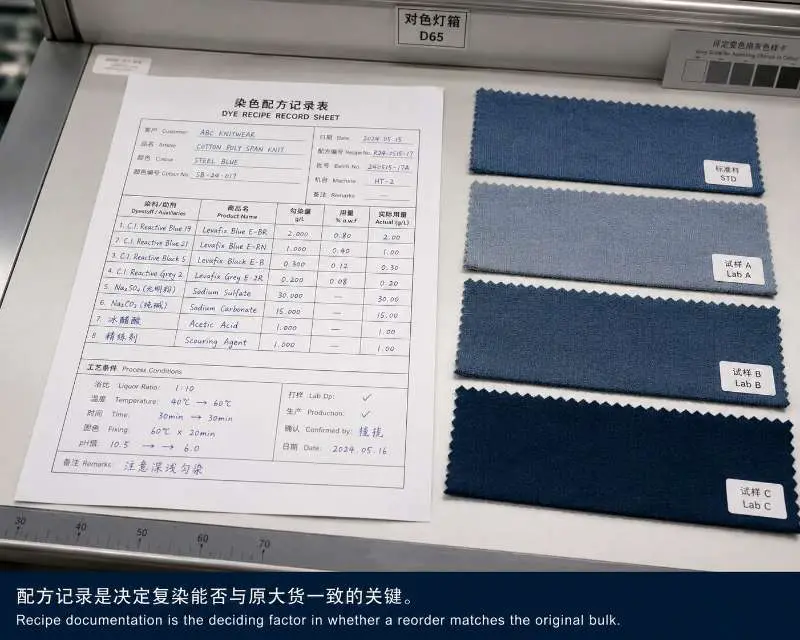
Most buyers treat lab dip approval as the endpoint of color development. It is only the starting point. A lab dip confirms that a target shade is achievable on one substrate, but repeatable bulk dyeing depends on the archived recipe behind it.
For custom-dyeing fabric, the buyer should confirm three records before reordering: dye ratios, auxiliary products, and the process curve. The recipe should identify dye types, auxiliary concentrations, temperature profile, liquor ratio, and the first approved bulk batch number. Without these records, the next batch depends too much on operator memory instead of controlled production data.
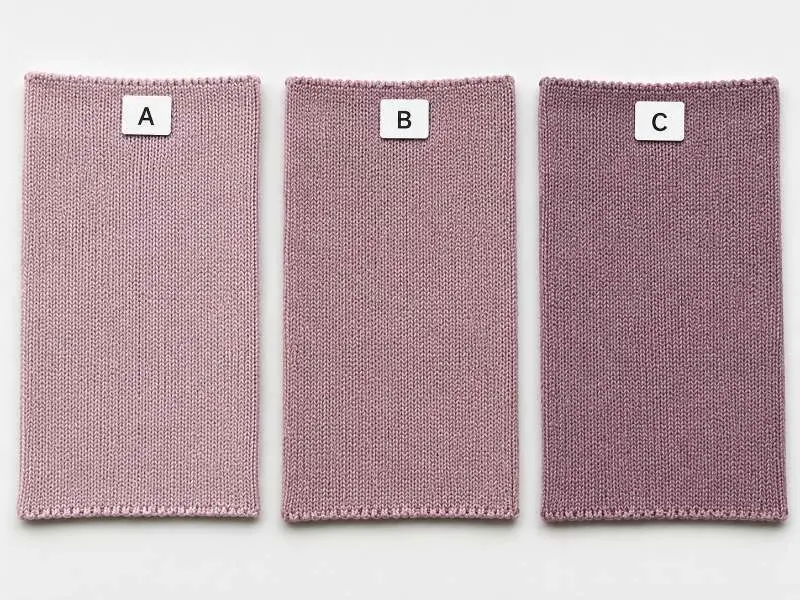
Even with a locked recipe, bulk-dyed rolls may show small shade differences. The issue is not whether variation exists, but whether it stays within commercial tolerance before cutting.
Shade bands solve this by grouping rolls against the approved standard, such as close match, acceptable spread, and edge-of-tolerance groups. Buyers should confirm that each shipment includes shade-band documentation and roll-level shade grouping. For deep shades like navy, black, and charcoal, or pale shades like ecru and off-white, request physical shade-band swatches before shipment so the QC team has a real reference for incoming inspection.
For visual color evaluation, buyers can also reference AATCC EP9 for visual assessment of textile color difference when defining internal shade-band review rules.
Reorder color failure is usually caused by a change that was not recorded before production. The most common risks are auxiliary substitution, machine changeover, and greige-lot drift. Even if the dye formula is unchanged, a different fixing agent, dyeing machine, circulation condition, yarn lot, or fabric density can shift the final shade.
Before approving a reorder, buyers should request four confirmations: the original approved bulk batch number, the same auxiliary product names, the machine or correction record used for the first bulk, and a strike-off dyed on the new greige lot. This last check is especially important for seasonal reorders because the recipe may be correct while the new fabric lot absorbs dye differently.
A jersey, rib, and fleece can share the same Pantone reference, but they should not share one dye recipe. Knit density, loop geometry, surface texture, and fiber blend all affect dye uptake and visual color depth. A brushed fleece and a smooth jersey may look different even when instrument readings are close, because surface reflection changes how the shade appears under store lighting.
For color-critical collections, each construction needs its own lab dip approval and recipe file. This is especially important when a jersey body fabric is paired with rib trim or fleece panels in the same colorway. If buyers compare dyeing with print options, custom dyeing gives deeper fiber penetration, while custom knit fabric printing supports pattern development but needs separate hand-feel and washfastness checks.
At minimum: a signed recipe sheet identifying dye types and concentrations (expressed as percentage on weight of fiber), the auxiliary products used by trade name, and the process curve (temperature profile and liquor ratio). Also, request the batch record number from the first approved bulk, which the mill can use to pull the original production log if a reorder dispute arises. For ongoing programs, a physical shade band set — swatches representing the approved tolerance range — should accompany the first delivery and be retained by your QC team as the reorder reference standard.
Yes, in most cases. Even if the fiber content is identical, a change in construction density, loop geometry, or surface finish changes how dye molecules interact with the fabric. Running the existing recipe on a new construction without a trial will produce shade drift, and in some cases fixation or washfastness issues. Budget a lab dip development cycle for each construction variant, even within the same colorway program. Mills that offer to skip this step for cost or time reasons are transferring the risk of color rejection to the buyer.
Runtang Textile supports custom dyeing fabric development for jersey, rib, fleece and interlock programs, with sampling and bulk production controls for color-critical orders. Request a sample or get a quote before your next reorder.
 Sustainability
3 Ways to Source Sustainable Cotton Fabric for Knit Apparel — and How to Choose
READ MORE Manufacturer Insights
Tie-Dye Knit Fabric Bulk Production: Process Control and Batch Repeatability
READ MORE Fabric Guide
Pointelle Knit Fabric: Openwork Stability, Yarn Choices, and What to Check Before Bulk Sampling
READ MORE Sustainability
Low-Impact Dye for Knit Fabric: What It Means, What It Covers, and How to Verify It Before You Order
READ MORE ڪپڙو
Beyond Fashion: The Multifunctional Magic of Tricot Fabric
READ MORE