2009년부터 이어온 니트 원단 제조사 · 중국
2009년부터 이어온 니트 원단 제조사 · 중국

Key Sourcing Takeaways
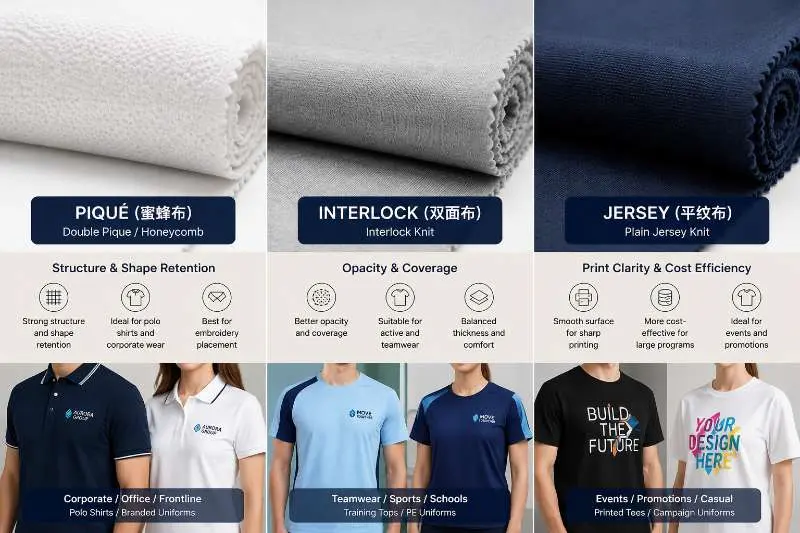
For many corporate polo and structured uniform programs, pique knit is often the starting point because its textured knit surface supports a cleaner uniform appearance and stronger shape retention than lighter single-knit options. But the right fabric for workwear depends on garment type, branding method, wash frequency and staff environment. Interlock and jersey still have clear roles when print clarity, opacity, layering comfort or cost control matter more than surface structure.
Pique knit is often specified for polo shirts and structured uniform formats because its raised surface texture supports embroidery, airflow and a cleaner staff-uniform appearance. Its defining characteristic is a double-knit construction that produces a raised surface pattern — typically a honeycomb or waffle texture at the fabric face — while maintaining a denser, stable underlayer. This combination delivers two qualities that uniform programs specifically demand: surface breathability and shape retention under repeated commercial wash cycles.
For corporate polo programs, hospitality front-of-house staff shirts, and retail chain uniforms, pique’s structured appearance occupies the visual middle ground between a formal button-down and a casual T-shirt. The raised surface texture also supports embroidery well: the dense double-knit base resists needle distortion and backing fabric pull better than single-knit alternatives, which is relevant for uniform programs requiring consistent branded logo placement on chest, sleeve, or collar positions.
Fiber selection for workwear pique carries practical sourcing implications. Cotton pique provides natural breathability suited to indoor service environments. Polyester or cotton-polyester blend pique constructions may deliver better dimensional stability across repeated high-temperature washing, depending on the specific construction and finishing — a meaningful factor for uniform programs where consistent sizing across a team’s garment lifecycle is a specification requirement. The optimal fiber blend depends on wash conditions and garment design; request pre-production wash test data before confirming the bulk specification rather than relying on general fiber generalizations.
GSM selection for workwear pique should be guided by intended wash frequency and wear conditions. As a directional reference, lighter-weight constructions may suit indoor corporate environments with moderate wash cycles, while heavier options are more appropriate for uniform sets cycling through commercial laundry facilities daily. Confirm the GSM range against specific wash test results from the target facility — GSM alone does not predict wash durability; construction, yarn quality, and finishing are equally decisive.
Runtang Tex produces pique knit fabric in cotton, polyester and blended constructions for polo shirts, corporate uniforms and branded staff apparel. Custom solid-color production starts at 200 kg per color, with stock fabric options available from 1 roll (~23 kg) per colour for sampling.
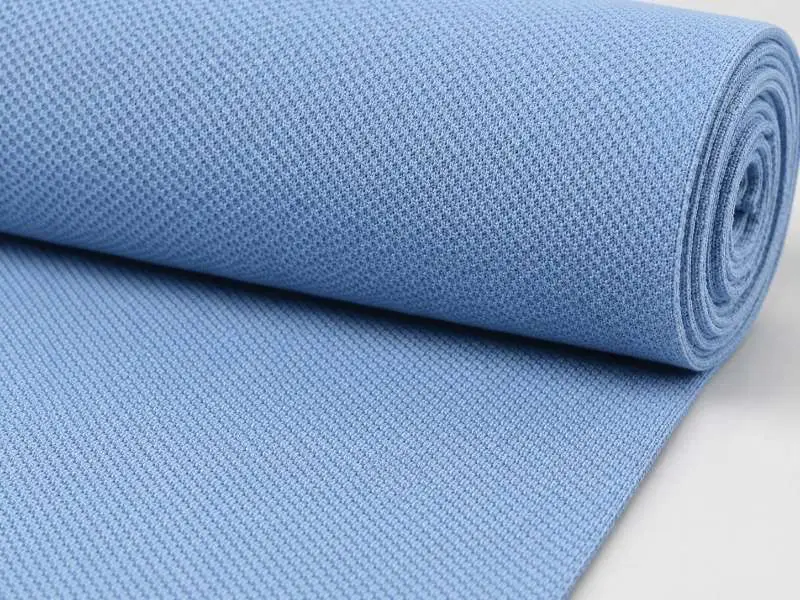
Where pique’s textured surface adds visual structure and promotes airflow, interlock knit produces a different performance profile: both faces of the fabric are identically smooth, creating a dense, opaque double-knit that serves hospitality and healthcare buyers across several dimensions pique does not cover as effectively.
Interlock’s smooth face makes it the preferred base for uniform garments carrying printed branding or requiring fine screen-printing clarity. The flat, even surface reproduces edge detail and color gradients more accurately than pique’s raised texture — a meaningful distinction for programs where brand identity standards govern print quality specifications. For hospitality and food service operations, refreshing uniform prints seasonally, consistent print-to-print accuracy across bulk orders is a sourcing priority that interlocks surface consistency directly.
From a skin-contact standpoint, interlock’s smooth double-face construction suits environments where staff are in uniform across extended 8-to-12-hour shifts. There are no raised surface contact points to create friction zones, and the double-knit density prevents the translucency under fluorescent lighting that single-knit alternatives can exhibit — an opacity requirement that patient-facing healthcare uniform programs often specify explicitly in their fabric briefs.
Durability-wise, interlock’s tight construction resists snagging well in environments where staff regularly contact furniture edges or equipment surfaces. Cotton-polyester interlock blends, depending on construction, can offer improved wrinkle resistance compared to 100% cotton constructions — a practical factor for programs where garments need to maintain a presentable appearance through a full service shift without re-ironing between wears.
Runtang Tex manufactures interlock knit fabric in cotton, polyester, and blended compositions, with bulk production MOQ starting at 200 kg per custom color.
Jersey knit — a single-knit construction — is usually the lighter and more cost-controlled option among the three structures. In workwear and uniform applications, its role is generally confined to inner layers, undershirts and base layers worn beneath structured outer garments, light-duty staff wear in low-abrasion environments, and programs where wash frequency is moderate rather than daily industrial.
The single-knit structure makes jersey noticeably lighter and more flexible than pique or interlock, which works well for layering pieces or uniform programs in warm climates where heat dissipation takes priority over structural durability. Jersey’s smooth face side also produces clear print results, making it suitable for branded inner shirts, secondary uniform layers, or staff T-shirts in casual retail or warehouse environments where a relaxed garment standard applies.
However, the jersey’s single-knit construction is a significant limitation in demanding workwear scenarios. The structure is more susceptible to pilling in high-friction contact zones compared to double-knit alternatives, and consistent dimensional stability across long-term bulk washing programs is harder to achieve without specific finishing treatments. For any uniform program involving 50 or more wash cycles per garment over its service life, double-knit options — pique or interlock — are the appropriate starting point for the structural garment layer. Jersey is best reserved for supplementary or inner garment roles where wash cycle count is lower and abrasion resistance is not a primary specification requirement.
See Runtang Tex’s jersey knit fabric range for base layer and light-duty uniform applications.
The defining technical gap between general apparel fabric sourcing and sourcing fabric for workwear is the wash standard. Corporate, hospitality, and healthcare uniform programs commonly cycle garments through commercial laundry facilities operating at higher temperatures, with stronger alkaline detergents, and with more mechanical agitation than domestic washing conditions, which expose performance gaps that standard swatch approvals and light-wash pre-production tests will not surface.
Before signing off on bulk production for a workwear program, sourcing teams should specify and verify the following parameters against the actual commercial laundry protocol the garments will face in service:
Colorfastness to washing and perspiration
For uniform programs using commercial laundry services, do not rely only on a light domestic-wash approval. Ask the supplier to test colorfastness against the actual wash temperature, detergent type and cycle count expected in service. The required grade should be set by the buyer’s brand standard or end-customer protocol. For darker shades, high-visibility colors and sweat-prone roles, include both washing and perspiration checks before bulk approval. For a deeper testing workflow, refer to color fastness testing for knit fabric.
Dimensional stability: shrinkage and spirality
For team-wide uniform programs, consistent sizing across production batches and across the garment’s service life matters for fit uniformity across staff. Specify acceptable shrinkage tolerances in both length and width directions, and confirm that spiral distortion (skew or torque) is within specification for your garment pattern. These values depend on the specific construction and finishing applied; request pre-production lab reports tested against your target wash temperature and cycle count rather than relying on general industry reference ranges.
Restricted-Substance Documentation for Skin-Contact Uniform Fabric
For uniform fabric worn directly against the skin in healthcare, food service, and hospitality environments, restricted-substance documentation may be required by the buyer’s compliance team. OEKO-TEX® Standard 100 certified options are available. Please confirm certification requirements, product class, fabric construction and colorway at the time of sampling.
For a detailed breakdown of test methods and grade thresholds applicable to knit uniform fabric programs, see color fastness testing for knit fabric.
Knit Fabric for Workwear: Comparison at a Glance
| 항목 | 피케 니트 | 인터록 니트 | 저지 니트 |
|---|---|---|---|
| 조직 | Double knit, raised honeycomb surface | Double knit, smooth face on both sides | Single knit |
| Best Workwear Use | Corporate polo, structured front-of-house uniforms | Hospitality, healthcare, print-heavy uniform shirts | Inner layers, light-duty staff wear |
| Wash Durability | High, when confirmed by wash testing | High, depending on construction and finishing | Moderate, not ideal for high-abrasion programs |
| 통기성 | High — micro-channel airflow from raised texture | Moderate — dense structure limits airflow | Moderate-High — lighter open structure |
| Print Clarity | Moderate — raised surface affects edge definition | High — flat surface supports precise printing | High — smooth face delivers clear results |
| Embroidery Suitability | High — dense base resists needle distortion | Moderate — adequate but less ideal than pique | Low-Moderate — limited structural backing |
GSM selection for pique knit workwear depends on the specific construction, fiber blend, and target wash frequency. As a general direction, lighter-weight constructions may suit indoor corporate environments with moderate wash cycles, while heavier options are more appropriate for programs cycling garments through daily commercial laundry. Rather than using GSM alone as a durability proxy, request pre-production wash test reports tested against your target temperature and cycle count before confirming the bulk specification.
Yes. Certified options may be available for selected pique, interlock or jersey constructions, depending on the fabric specification and sampling requirement. Confirm the certification scope, product class and colorway before bulk approval, especially for healthcare, food service and hospitality uniforms worn directly against the skin.
Custom solid-color production at Runtang Tex starts at 200 kg per color. For programs requiring multiple colorways, each color is assessed separately at this MOQ. Stock fabric options are available from 1 roll (~23 kg) per colour for development sampling before bulk commitment.
Runtang Tex manufactures pique, interlock, and jersey knit fabric for corporate and hospitality uniform programs across Europe, North America, and Australia. Request a sample to verify colorfastness and wash performance before committing to bulk production.


