Knit Fabric Manufacturer Since 2009 · China
Knit Fabric Manufacturer Since 2009 · China

A fitted T-shirt or bodysuit that bags at the seat after three washes is not a quality problem — it is a specification problem. The decision between cotton vs cotton spandex jersey is not simply about adding elasticity to a fabric; it determines how a garment holds its shape across a production run, how buyers specify approval criteria at the sampling stage, and how the cost difference compounds across bulk orders. This article lays out the sourcing trade-offs that matter.
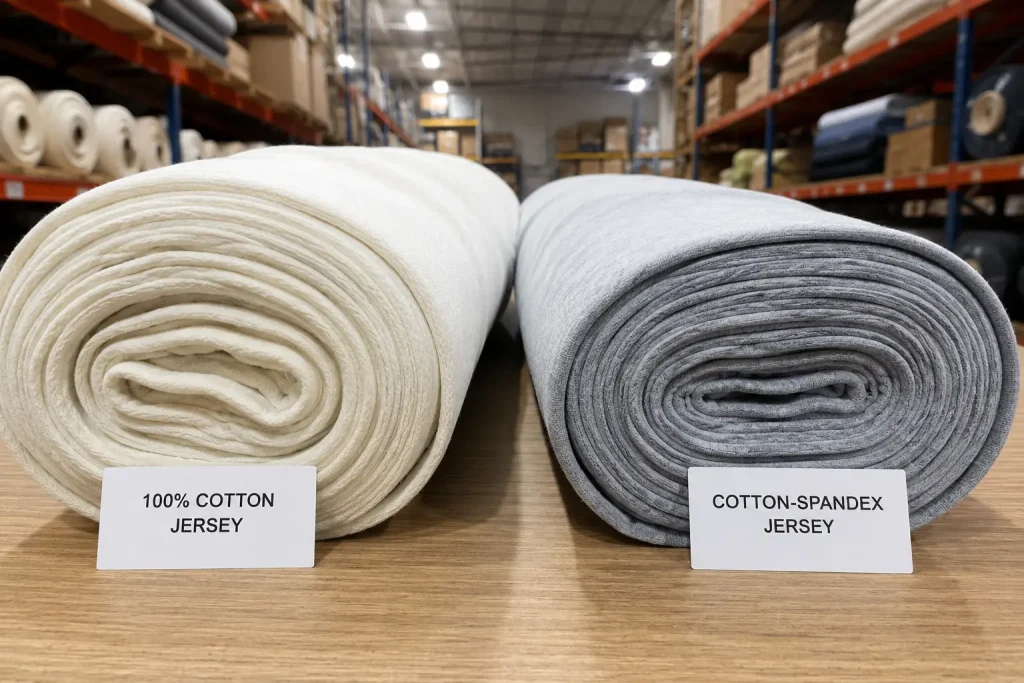
Standard jersey knit fabric built from 100% cotton delivers a natural two-way stretch — the knit structure itself provides horizontal give, but little meaningful recovery in the length direction. Once a cotton jersey garment is placed under sustained load (worn repeatedly, machine-washed on a warm cycle), the loops progressively elongate and the fabric does not reliably return to its original dimensions.
Introducing spandex into the yarn blend changes the mechanical behaviour of the loop structure rather than just adding a secondary fibre. At lower spandex proportions — such as a 95/5 cotton-spandex construction — the primary function is dimensional stability: the fabric resists the progressive elongation that characterises repeated-wear cotton. At mid-range proportions, such as 92/8 depending on construction, the fabric is more likely to support stronger stretch response in both course and wale directions. However, four-way stretch should still be confirmed through sample testing, not assumed from blend ratio alone.
The term "four-way stretch" is widely used in product listings, but it is not a single performance point. Recovery rate — how quickly and completely the fabric returns after being stretched — depends on spandex proportion, the yarn count used, the knit gauge, and finishing processes applied. Sourcing teams should treat blend ratio as a directional indicator, not a fixed performance guarantee, and verify actual recovery behaviour through wash testing on sealed samples. For a detailed breakdown of how stretch and recovery interact across knit structures, see stretch and recovery in knit fabric.
Fabric weight and fibre blend are two separate variables that produce combined outcomes. A common sourcing error is specifying one without constraining the other.
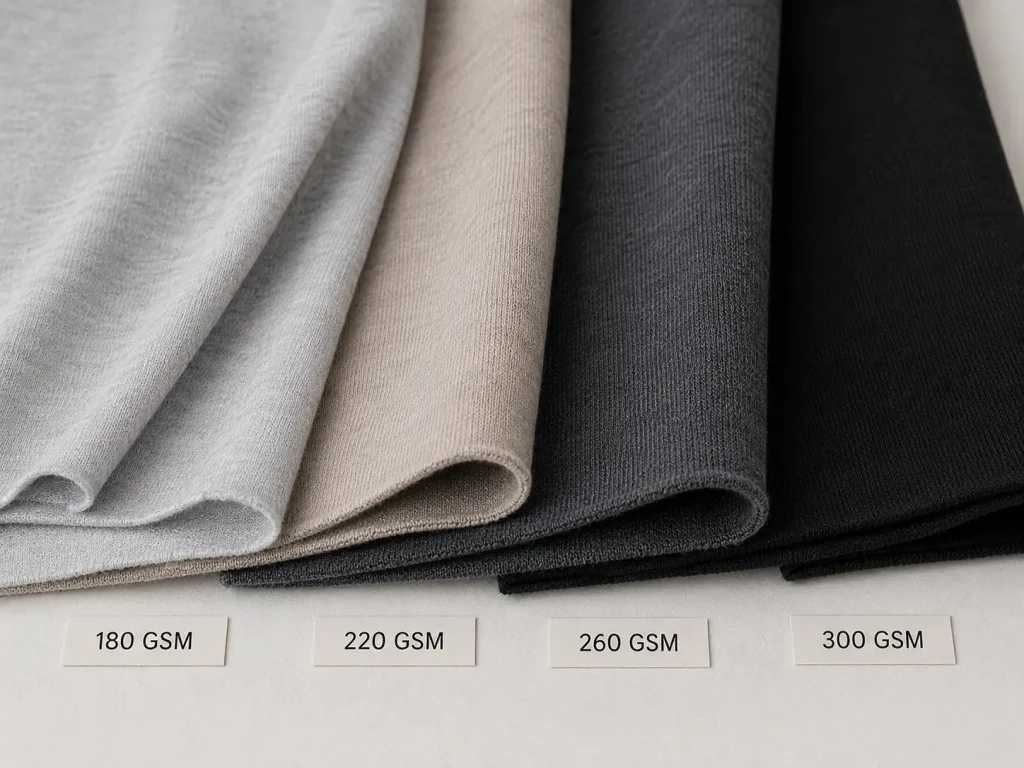
A 160 GSM cotton-spandex jersey at 95/5 and a 220 GSM cotton-spandex jersey at 92/8 are both correctly described as "cotton-spandex jersey," but they behave differently in cut-and-sew and produce different end results. The lighter construction may drape well for slim-fit T-shirts but offer insufficient opacity or structural body for fitted dresses. The heavier construction may be appropriate for leggings or body-contour garments where recovery under compression load matters.
For sourcing purposes, the relevant groupings are roughly:
| Dimension | 100% Cotton Jersey | Cotton-Spandex Jersey |
|---|---|---|
| Stretch direction | Mainly widthwise mechanical stretch | Higher stretch potential in width and length, depending on construction |
| Recovery after stretch | Moderate — may bag over time | Higher — returns to original shape |
| Typical spandex content | None | 5%–10% depending on construction |
| Fit category | Relaxed/boxy styles | Fitted, semi-fitted garments |
| Relative fabric cost | Lower | Moderately higher |
| Shrinkage tendency | Higher — pre-shrink advised | Lower — spandex stabilises structure |
Note: the GSM ranges above are indicative reference points. Actual suitability depends on construction, finishing, and garment cut. Confirm performance at the sampling stage before committing to a bulk specification.
The cost difference between cotton and cotton-spandex jersey is visible at the fabric sourcing stage — the spandex blend typically carries a higher unit cost. What is less visible at the sourcing stage is the downstream cost of using 100% cotton in a garment category where shape retention under load is a performance requirement.
For relaxed-fit garments — oversized tees, wide-leg trousers, loose hoodies — 100% cotton jersey remains an appropriate specification. The garment architecture does not place the fabric under sustained directional load, and the recovery requirement is low.
For fitted or semi-fitted garments — slim-cut T-shirts, fitted polo blanks, bodysuit bases, fitted loungewear — 100% cotton jersey carries a shape-retention risk. The fabric may perform acceptably in the first-wash sample but deteriorate across the wash cycles that represent a garment's actual service life. Bagging at the seat, knee, or sleeve cuff is a characteristic failure mode. These failure outcomes translate to consumer returns, reorder pressure, and brand reputation cost that do not appear in a fabric price comparison.
For rib knit fabric used in cuffs, neckbands, and waistbands — components that are placed under repeated stretch-and-recovery load every time the garment is put on or taken off — cotton-spandex is the standard construction. The performance logic is more acute in these components than in the body fabric, because even a small amount of permanent stretch in a cuff or neckline makes the finished garment appear worn and inconsistent.
The sourcing decision, framed correctly, is not "cotton vs cotton spandex" as a general preference. It is: what recovery demand does this garment architecture place on the fabric, and does 100% cotton reliably meet that demand across the garment's expected wash cycles?
Stretch performance should be verified at the sealed sample stage, before bulk commitment. A spec sheet that records only fibre content and GSM is insufficient for fitted-garment categories. The following criteria are worth including in sampling approval documentation:
Standardised textile testing should be selected according to the buyer’s approval criteria. AATCC standard test methods can support wash-related dimensional-change evaluation, including fabric and garment dimensional changes after laundering. For stretch-and-recovery percentage, confirm the exact test method with the buyer, mill, or nominated lab before bulk approval.
For cotton-spandex jersey specifically, ask the mill to provide the spandex ratio in the actual production fabric — not just the specification used in sampling. Variation in spandex content between the sample and bulk can cause performance inconsistency, especially when the spandex proportion is at the lower end of the blend range.
For fitted silhouettes — slim-cut tees, body-contour tops — cotton-spandex jersey is the lower-risk specification because it maintains dimensional stability across wash cycles. 100% cotton jersey is appropriate for relaxed or oversized cuts where the recovery demand on the fabric is low. The decision should be made against the garment architecture, not as a general preference. Request wash-cycle recovery data from the mill at the sampling stage before committing to a bulk specification.
Yes. Runtang Tex can review the requested GSM, spandex proportion, finish, and end use at the sampling stage, then confirm whether the target specification is suitable for development.
Custom solid colour orders for cotton-spandex jersey carry a minimum order quantity of 200 kg per colour. For general custom development, the minimum is 1,000 kg. Stock fabric options start from 1 roll (~23 kg) per colour. MOQ requirements are confirmed at the quotation stage based on construction and colour specification.
Runtang Tex produces jersey knit fabric — including cotton and cotton-spandex variants — for apparel brands across Europe, North America, and Australia. Request a sample or get a quote to start your sourcing process.
 Tekninen osaaminen
Types of Fibers Used in Jersey Knit Fabric
READ MORE Tekninen osaaminen
Waffle Knit Fabric Shrinkage: What Apparel Brands Need to Know
READ MORE Toimialan näkemykset
Jersey-neuletekniikka puuvillamateriaalilla
READ MORE Kangas
Fabric Weight: A Guide to Material Selection
READ MORE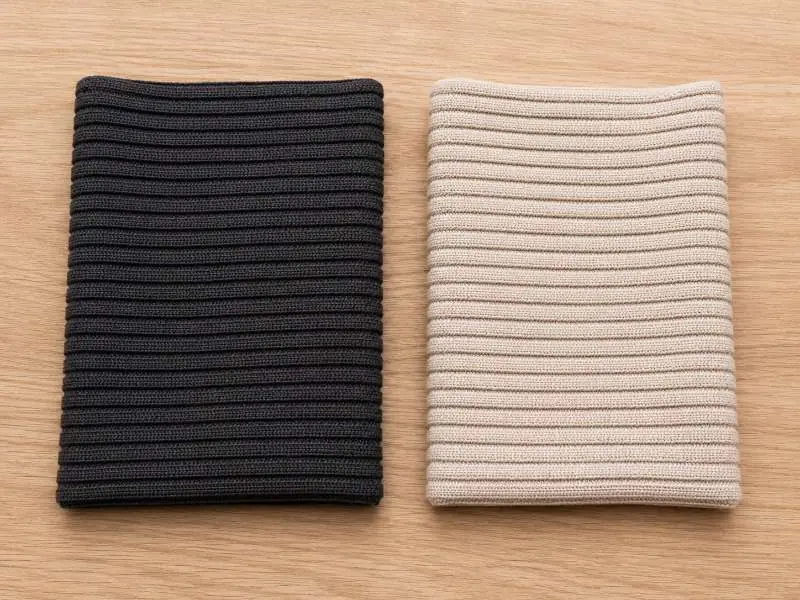 Fabric Guide
Ottoman Knit Fabric for Structured Apparel: Rib Texture, Recovery and Cutting Spec
READ MORE